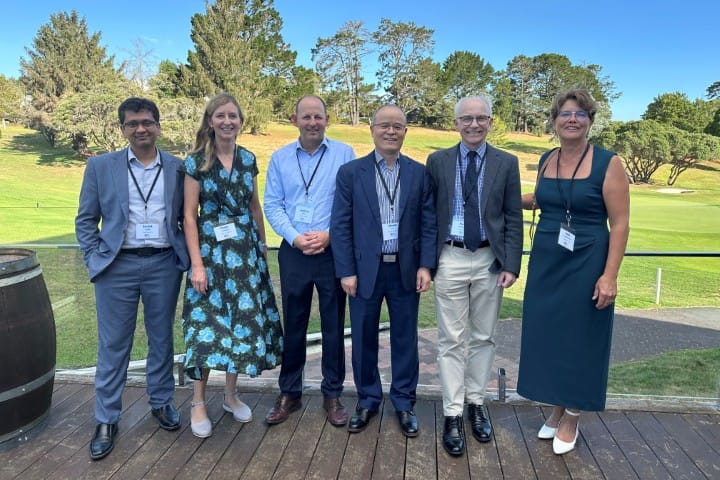
A record number of guests joined Eye Doctors’ alumni at the Remuera Golf Club to celebrate two decades of teamwork, community engagement and outreach work, and discuss several challenging cases at Eye Doctors’ first Grand Round for 2025.
Despite ex-Tropical Cyclone Alfred building in Brisbane, the evening’s keynote speaker and Eye Doctors co-founder Professor Shuan Dai had crossed the ditch from the Queensland Children's Hospital and Queensland University to be part of the celebrations. He kicked off proceedings with two unusual cases – one concerning multiple sclerosis and the other central nervous system glioma. Both were wrongly perceived to be vertical strabismus caused by fourth-nerve palsy, also known as superior oblique (SO) palsy. Prof Dai noted, however, that when there’s head tilt and torsion mismatch it can indicate an underlying and potentially life-threatening condition involving the cerebellum and/or brainstem. Think ocular tilt reaction (OTR) – a triad of skew deviation, head tilt and paradoxical conjugate ocular torsion in the same direction as the tilt. Fundus photography can determine the different causes of ocular torsion and using the Parks-Bielschowsky three-step test (determining which eye is hypertropic, does the hypertropia increase in right gaze or left gaze and does the hypertropia increase with right or left head tilt) can also help differentiate OTR from SO palsy. The condition can improve or resolve after successful treatment of the underlying disease but, importantly, early diagnosis can be lifesaving, he said.
Patience is the word
Dr Julia Escardo-Paton then shared a case of ophthalmology taking “two steps forward, one step back”. There are patients who truly have it all and an 80-year-old man of Chinese ethnicity, was one such case, she said. With a long medical history, including previous bilateral medial orbital decompressions for optic neuropathy, he was referred by an orbital surgeon for ocular surface disease due to thyroid orbitopathy. He also had diplopia, glaucoma and hazy vision. The patient underwent squint surgery (6mm bilateral medial rectus recessions, R 4mm, L 5mm inferior rectus recessions, plus left temporary tarsorrhaphy) and later, bilateral cataract surgery. The surgeries, especially the first, were complex with a long recovery but ultimately the patient’s vision improved, intraocular pressure decreased (he came off his drops) and the ocular surface improved, said Dr Escardo-Paton. Lessons learnt included glaucoma drops with preservatives are toxic, large-angle squints can exacerbate ocular surface disease, tight muscles will cause secondary glaucoma and lagophthalmos and tight inferior recti preventing Bell’s reflex is a bad recipe for the ocular surface. Dr Escardo-Paton stressed the importance of explaining surgery’s limitations every step of the way, adding both surgeon and patient patience is a virtue!