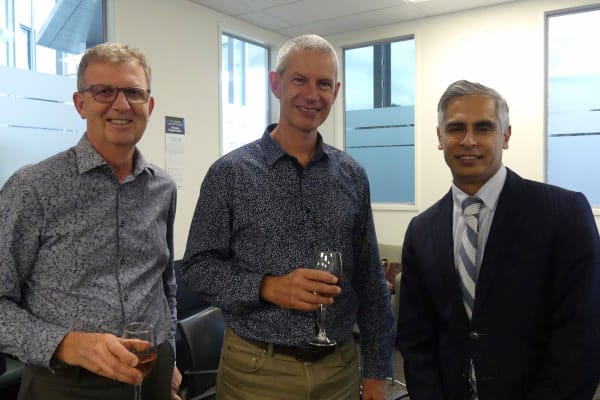
Eye Surgery Associates first case study evening of the year focused on “tricky” cases. Drs Hussain Patel and Monika Pradhan welcomed a small group of optometrists to share and discuss some of their more unusual case studies, many of which focused on glaucoma, in an informal setting at Southern Cross’ Specialist Centre on Auckland’s North Shore.
Meningioma
To start the evening, Dr Pradhan introduced two cases. The first, a 24-weeks pregnant 40-year-old who presented with progressive reduced vision in her left eye and visual field loss. The optical coherence tomography (OCT) and visual field results showed no abnormalities, indicating the issue was neurological, she explained. The patient was referred for an urgent MRI scan, which revealed a suprasellar meningioma. Dr Pradhan said most meningiomas are benign (90-92%) and slow growing, although 7% are atypical and 2% anaplastic (malignant).
Meningiomas are more common in women than men and are usually sporadic. Risk factors include exposure to ionizing radiation, say from a history of dental x-rays, and the rare genetic disorder neurofibromatosis type 2 (NF-2). Symptoms include focal seizures, motor and sensory loss, visual loss and diplopia and III and VI nerve palsy. Smaller tumours (>2cm) are usually asymptomatic, said Dr Pradhan, adding that treatment for smaller asymptomatic tumours is usually observation while larger tumours need surgical resection and sometimes preoperative transarterial embolisation as well as radiation.
Glaucoma and other cases

Another case presented by Auckland University teaching fellow Kathryn Sands focused on a normal tension glaucoma patient and when to start further glaucoma treatment. The patient’s OCT scans showed they had retinal nerve fibre layer (RNFL) thinning of 10-15 microns while eye pressure remained borderline (IOP R14/L16 stable since 2016) and the patient was currently on Hysite (nocte, both eyes).
The group agreed it was an on the fence case. “Although ideally, you’d like to see OCT progression to match visual fields, considering treatment is not unreasonable,” said Dr Patel. Treatments discussed included selective laser trabeculoplasty (SLT) and Timolol. For this patient, however, Dr Patel said he would consider SLT as the patient had a family history of circulation problems and asthma, so Timolol was not suitable. It was agreed this patient needed to be monitored, have a second OCT and be advised carefully about the different treatment options available, so they could make an informed choice with their doctor.
Nearly all optometrists present had brought one or two cases to discuss and topics varied from how often you should monitor patients (Dr Patel suggested every nine months); what eye pressures you should be aiming for; the advantages and risks of surgical treatments like Xen, iStent and trabeculectomy; personal public referral experiences; and a few other unusual cases.
One of these was presented by optometrist Sarah Denny who’s case involved a patient presenting with only five spots of vision left. He claimed his peripheral vision was great and only realised the seriousness of his situation when advised he was going to lose his driver’s license. Judging from the reactions in the room, similar scenarios happen more often than we would like to believe!
Dr Patel ended this engaging peer review evening with a case involving asymmetry in optic disc cupping and high IOP who he’d lined up for the water drinking test, a possible MRI and some blood tests.
Eye Surgery Associates will run its next case study evening on 23 July, both in Auckland.