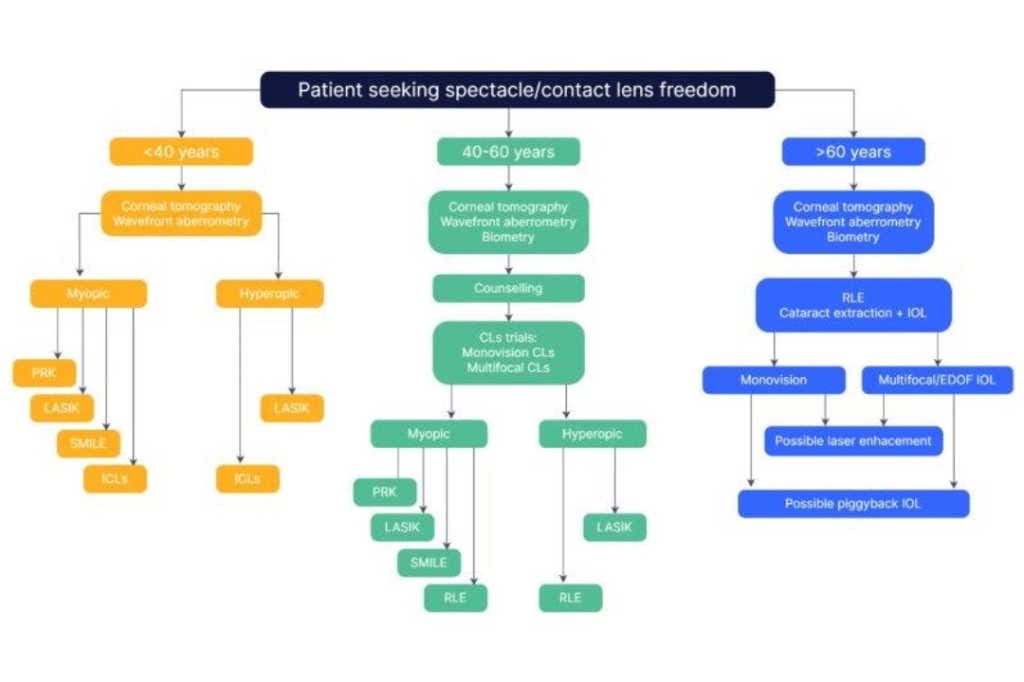
There was a time when refractive surgery was very much the domain of those surgeons who specifically specialised in excimer laser treatment of the cornea, but rapid advances in corneal refractive surgery techniques and intraocular lens (IOL) technology, as well as greater patient expectations, have brought us to a point where the majority of ophthalmologists who perform cataract surgery can consider themselves refractive surgeons. As an optometrist or ophthalmologist presented with a patient requesting to be spectacle- or contact-lens-free, what options are there and how do we approach them?
Patients under 40 years old
Patients under 40 years old represent a relatively straightforward group. The vast majority are myopes, although there will be a small number of relatively high hyperopes. Pre-operative refractive stability must be established (which usually means the minimum age for refractive surgery is around 20 years) and to reduce the risk of post-operative keratectasia (iatrogenic keratoconus) all patients require careful pre-operative screening with corneal topography/tomography, as well as an assessment of risk factors, such as eye rubbing and atopy. Dry eye must be assessed and treated vigorously pre-operatively as most laser techniques result in temporary dry eye, particularly in those with pre-existing dry eye.
PRK
Photorefractive keratectomy (PRK) is the original excimer laser treatment, involving removal of the corneal epithelium and precise reshaping of the cornea underneath with an excimer laser. While it results in excellent visual outcomes, it’s a painful procedure to recover from and visual rehabilitation can be slow. Although it has been largely superseded by laser-assisted in situ keratomileusis (LASIK) and small incision lenticule extraction (SMILE), it still represents the safest option for patients with thin corneas.