







Visual stress? Those words meant nothing to me until Christmas 2024, when I was at a work event and met Kimberley Harrison, the CEO of Cerium Visual Technologies (CVT), a UK company helping a subset of children and adults who struggle to read due to visual stress.
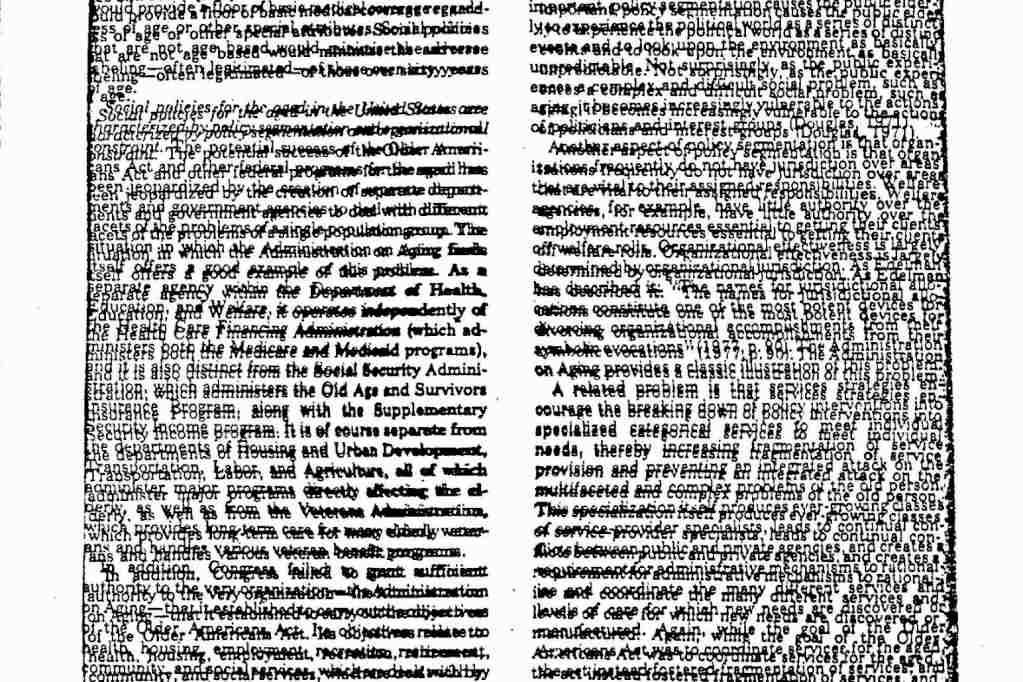
I discovered that visual stress means difficulties an individual experiences when reading text, particularly when it is set against a white background. Additionally, smaller text can make reading harder, as words and letters seem to move. While I was chatting to Harrison and finding out more about this and her company, I suddenly realised what she was saying about visual stress described my 10-year-old daughter!
Ever since my daughter started school at the age of four, my husband felt her reading was unusual: she would mispronounce words because she sounded them out differently from others. As time went on, my husband suspected she may be dyslexic, but I wasn’t completely convinced because she did not struggle with some of the typical dyslexia symptoms. She could follow steps; her reading comprehension was great and she always passed her school’s fluency tests – not with flying colours but, nevertheless, with a pass.
Taking the first colorimetry test
Following the light-bulb moment with Harrison, we monitored our daughter’s reading habits closely and noted she lacked any interest in reading; the only books she enjoyed were below her age range, something I had assumed to be laziness but now began to wonder about more deeply.
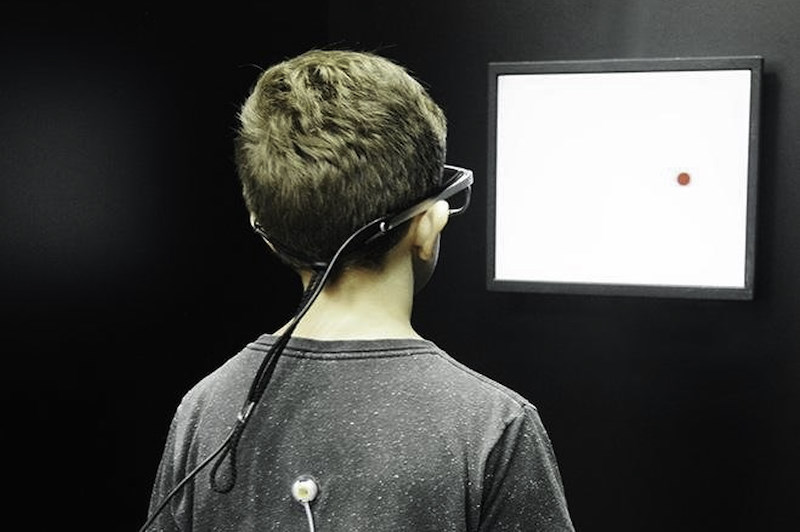
Fortunately, I had the chance to take her to CVT for a quick examination during an exhibit at London’s 100% Optical. The team had an Intuitive Colorimeter on the stand and I asked if they could conduct a brief test, understanding that the results wouldn’t be entirely accurate since the assessment requires a dark environment.
The test was performed by CVT managing director Claire Millar, who has a degree in clinical optometry. She told me CVT is licensed to manufacture and distribute the Intuitive Colorimeter – a machine used to test the exact colour the patient needs to eliminate their visual stress – and that testing is typically carried out by qualified optometrists, orthoptists and other eyecare professionals with specific training in visual-stress assessment. The test indicated a significant likelihood that my daughter was experiencing visual stress. It felt like a huge weight was lifted. We finally discovered how we could support her and ignore the school's increasing demands for her to read faster.
Digging deeper
I was also lucky to be working in a sector where I know where to find help. As soon as we had the initial result, I asked Harrison to recommend a CVT client who was using colorimetry to run a more thorough examination. We found someone who was recommended as one of the best visual-stress specialists in our region.
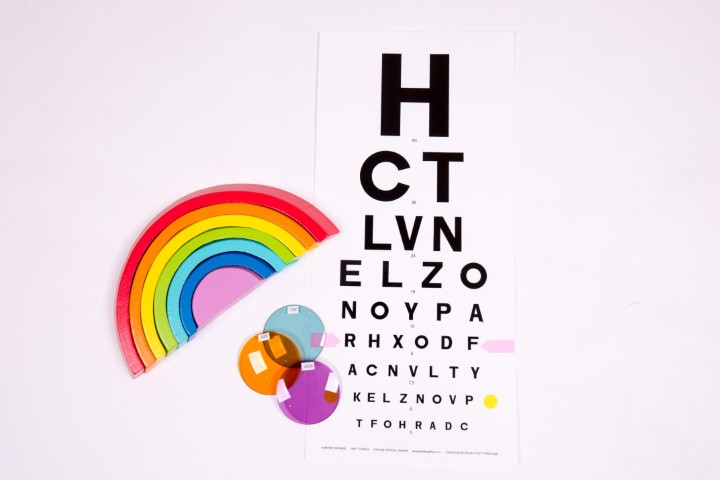
My daughter had a two-part consultation, with each session spaced approximately two weeks apart. The first included a full eye examination, followed by a test using colour filters to identify which specific hues might alleviate her visual stress. This examination narrowed it down to three potentials. Next, she underwent a series of tests to assess her reading speed with and without filters to find out which one enhanced her performance the most. The colour she needed was a shade of purple.
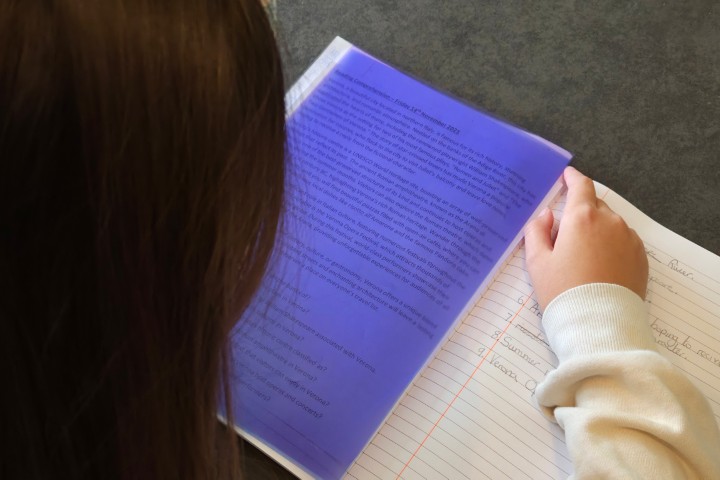
Following this assessment, she was advised to use an A4-sized plastic purple filter closely matching her identified colour while reading for the next four weeks. This was to help assess whether she truly required it; our visual stress specialist explained that some children might just pick their favourite colour, which could result in no real benefit. Moreover, if a child recognises the advantages of using the coloured filter, they then feel they cannot live without it, especially at the age of 10 where they know the difference and are able to verbalise it.
The specialist originally suggested four weeks of use because, at 14.7%, my daughter was just below the 15% threshold for reading speed, placing her within the acceptable range for visual stress. But after seeing how beneficial the coloured sheet was, I requested a follow-up appointment sooner. After two weeks my daughter became completely reliant on the coloured sheet. Her teacher noticed an improvement in reading fluency; she no longer struggled with the words that she once tripped on. For the first time in her life, letters stopped “jumping around”, allowing her to read them accurately.
The second part of the examination involved the use of the CVT machine in a way that was based on my daughter’s answers to questions about her experience with the filters.
The machine was calibrated to match the purple of my daughter's sheet, then she was tested using varying shades of it to see how her eyes reacted. They alternated between marginally more red or marginally more blue, aiming to pinpoint the precise tone to offer the greatest benefit.
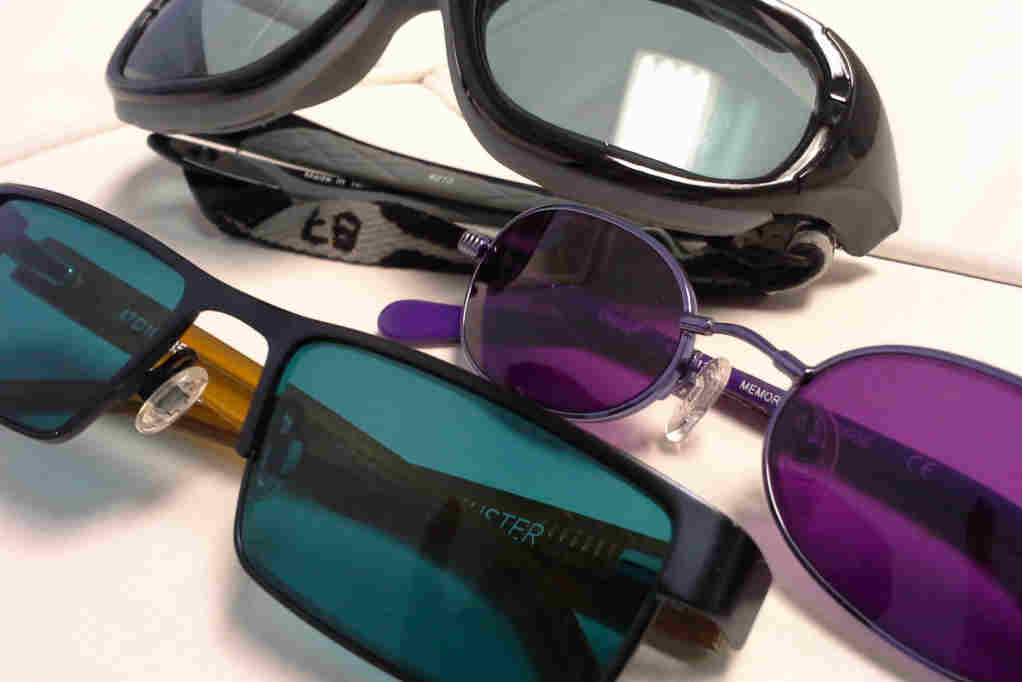
The machine produced a series of codes corresponding the ideal shades of purple, which were used to choose lens tints. They were fitted into a temporary pair of plastic glasses, which she wore to read under normal lighting conditions to assess their effectiveness. She tried five shades of purple that were difficult to differentiate with the naked eye but, under light, faintly distinct. The care and precision of this part of the examination blew me away and Harrison explained to me why that matters. "Precision is key because even small deviations in hue or saturation can significantly alter the therapeutic effect of the lenses for some patients." I hadn’t realised generic coloured lenses just wouldn’t cut it and they need to be tailored exactly to suit a patient’s need. A darker purple with a stronger blue hue proved to be the optimal colour for my daughter.

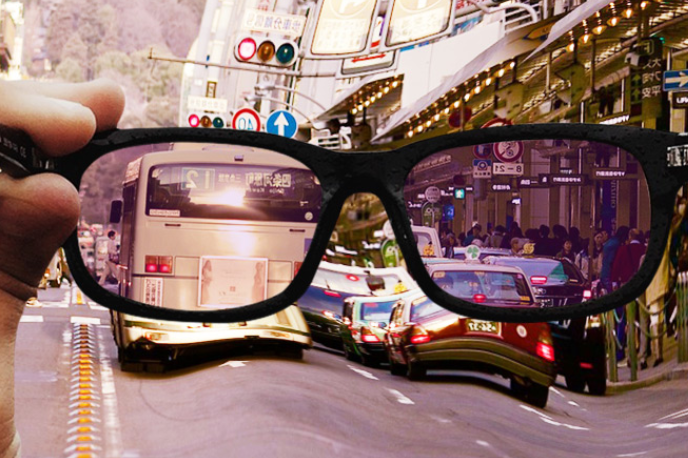
Spectacles for visual stress in a bespoke purple
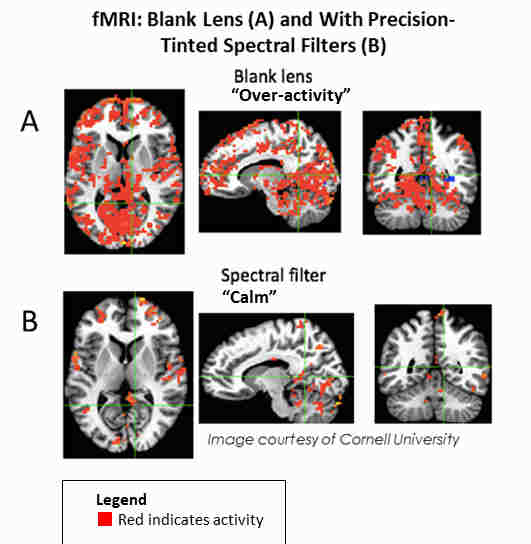
Doing the lens test under normal lighting conditions was crucial, as even slight variations may not be as helpful for her visual stress. This step also served to verify the accuracy of the codes generated by the machine. I was told that once the optimal colour is identified using the Intuitive Colorimeter, it is digitally mapped and matched with over 10,000 possible colour combinations. Each pair of lenses is manufactured using a controlled, spectrophotometrically verified dyeing process to ensure the final tint precisely matches the prescribed specification. That level of accuracy explains why my daughter’s glasses have made such a difference – they’re not just purple, they’re her purple for visual stress.
Visual stress and dyslexia
Through this experience, I learned that visual stress is often confused with dyslexia since they share similarities. Dyslexia is a language-based learning difficulty, whereas visual stress affects the processing and comfort of the visual input. There are ways to differentiate the two.
With dyslexia, the person often finds decoding words, sounding them out, retaining information, organising letters and numbers and understanding text a challenge. Those with dyslexia often spend so much time decoding words that they struggle with comprehension. So while dyslexics may experience visual stress, not everyone with visual stress is dyslexic, which is apparent in my daughter’s case. She did not have any dyslexia symptoms; her only real struggle was reading smaller words and those written in black on a white background, which she could read perfectly if they were larger. She also spelt ‘beautiful’ in about five different ways because the letters often seemed to jump around, making it hard for her to remember the correct spelling. She has only just learned that letters shouldn't jump; she thought everyone read words the same way she does.
I was excited to share with my daughter’s school how visual stress differs from dyslexia and how they can inform other parents. I've learned many families are unaware of visual stress and in fact a girl in my daughter’s class also struggled with the same problem. She now wears orange-tinted lenses!
For eyecare professionals, perhaps during a routine eye examination, I suggest asking the child if they find it hard to read black and white text or if letters seem to move; these phenomena can indicate visual stress. Including these two questions during a routine eye check could help families facing similar challenges.
Life after diagnosis
As I write this, my daughter has been wearing her glasses for six months and I can confidently say it has made a significant difference. She is now reading books appropriate for her age, willingly picking them up and enjoying them, which never happened before. Additionally, her schoolwork has improved dramatically; she can spell better and is able to complete her work faster.
I asked the school to test her one month after she got her new glasses and the results exceeded my expectations. Asked to read a set passage in two minutes, not only did she finish it quickly, but she was also able to read more than the test required.
Looking back, I can’t help but feel a wave of guilt thinking about how long my daughter was struggling, assuming the way she saw the world was normal. However, I also feel incredibly grateful for that key Christmas conversation, for the amazing support we received from eyecare professionals and, most of all, for the way my daughter now lights up when she reads, does her homework and learns her lines for her performing-arts activities.
Our journey has changed everything for her and us; it improved her confidence and we parents can finally stop stressing. I hope by sharing our story it helps to open up the conversation between optical professionals and patients.
Declaration: Siu-Ying paid in full for the CVT diagnosis service. The only gift received was a frame from the Stepper Start range. The total cost for the two consultations, A4 plastic filters and CVT lenses was £380 (NZ$883). The CVS system is used in many parts of the world, including Australia but not currently in New Zealand.

Born in Hong Kong and based in the UK, Siu-Yin Shing is a freelance writer and a regular contributor to NZ Optics. She also has an eyewear blog, myglassesandme.co.uk