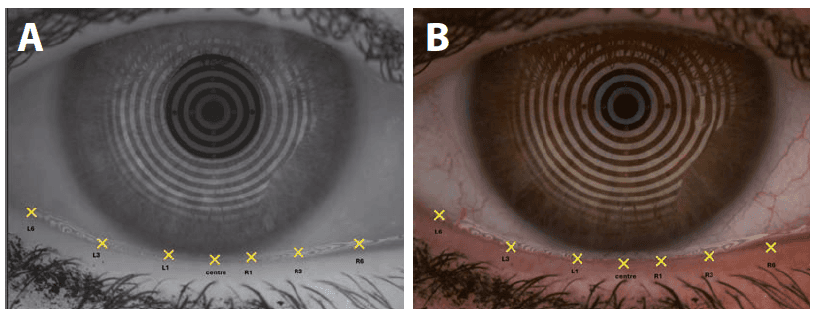
Dry eye disease significantly impacts patient wellbeing worldwide1,2. Tear meniscus height (TMH) is a critical aetiological indicator of aqueous-deficient dry eye, with TFOS DEWS II guidelines defining <0.20mm as the deficiency threshold3,4. Clinical TMH measurement reliability could vary according to the location of image capture along the lower lid margin, or to the timing of assessment relative to a blink, or to the illumination used5. To address these potential inconsistencies, we, together with OSL's Professor Jennifer Craig during her research visit to Aston University, aimed to optimise a standardised protocol using digital video imaging and image analysis6.
Methods
A total of 38 healthy adults (mean age 33 ± 10.6 years; 45% male) were evaluated with the Oculus Keratograph 5M6. After two non-forced blinks, the lower tear meniscus was video recorded for five seconds, under infrared light, then white light. This was repeated twice. Participants also completed the Ocular Surface Disease Index (OSDI), and tear film stability was assessed via three averaged non-invasive keratograph breakup time (NIKBUT) measurements5,6.