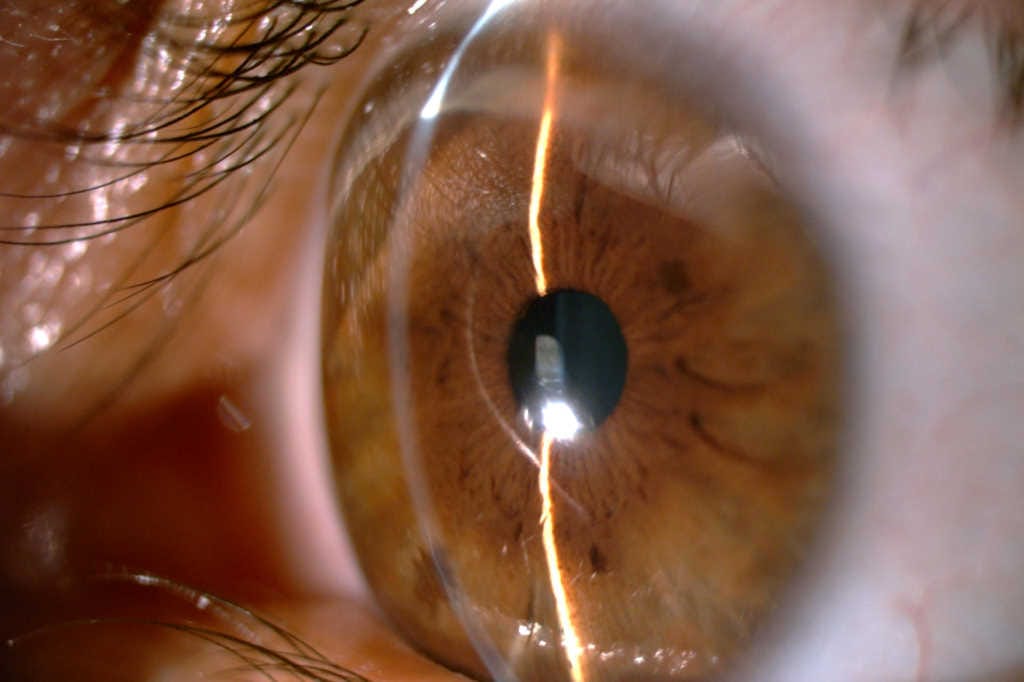
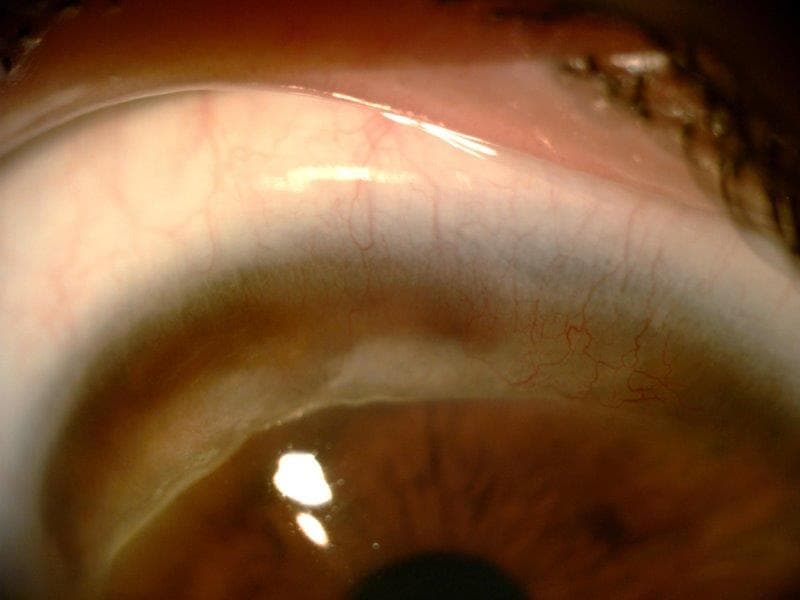
The diagnosis of TMD is typically clinical and involves ruling out other peripheral corneal thinning disorders such as Mooren ulcer, peripheral ulcerative keratitis, peripheral microbial keratitis, Fuchs’ superficial marginal keratitis, dellen or pellucid marginal degeneration. Unlike TMD, which is painless, most other differential diagnoses present with ocular pain, photophobia, and/or lacrimation. Common findings in establishing the diagnosis of TMD include an intact corneal epithelium with peripheral (typically superior or supero-nasal) corneal thinning, lipid deposits at the leading edge alongside a steep central edge, superficial limbal vascularisation over the thinned cornea and conjunctival hyperaemia without other inflammatory findings3. The thinning spreads circumferentially in a crescent-shaped fashion, similar to a Mooren ulcer, but TMD does not progress centrally and the central edge is not undermined. Questions have been raised in the literature about the presence of an inflammatory subtype of TMD, presenting with recurrent ocular pain, conjunctival hyperaemia, epiphora and photophobia1. However, consensus to date suggests that the described symptoms and clinical findings are attributable to concurrent episcleritis1 or other associated corneal or systemic diseases rather than a direct result of TMD itself2.
In TMD, the corneal thinning commonly starts superiorly or supero-nasally, resulting in a local flattening of the cornea1. Subsequently, relative steepening of the meridian perpendicular to the meridian that has thinned, produces significant against-the-rule astigmatism (up to 30D), which decreases visual acuity3. While progression is typically slow, it varies markedly from case to case, so regular follow-up is recommended3. With increased thinning, the risk of corneal perforation increases. Rates of perforation (both spontaneous and traumatic) are around 10-15%1 and are associated with poor visual outcomes even with prompt repair1. Because of this, education on the need for caution – and in advanced cases, protective eyewear – should be provided to TMD patients2.
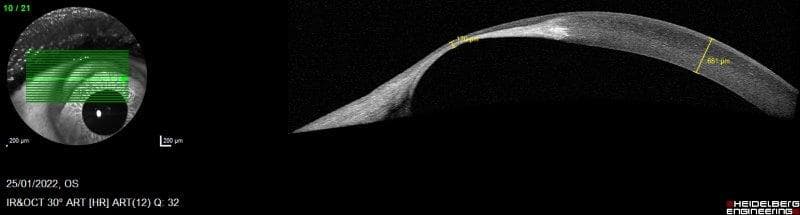
Anterior segment OCT is a useful monitoring tool as it provides high-definition cross-sectional images of the cornea, allowing the thinning to be visualised and measured. In 2015, a new staging system was proposed based on OCT findings including: 1) anterior and posterior corneal curvature, and 2) thickness of the thinnest part of the cornea4. This provides an objective way to document progression of TMD and allows for better surgical planning and therefore prevention of perforation than the previous Süveges classification, which was based mainly on the width of the corneal lesion4.