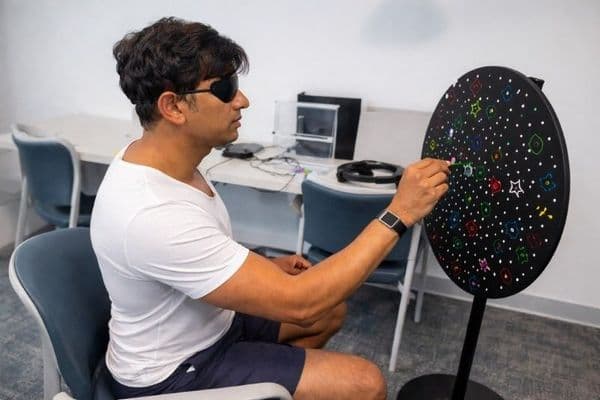
When considering how vision works, it is tempting to treat the retina as a digital camera. It converts light into electricity, performs some simple computations and reliably (but passively) conveys the result to the user, who is left to make sense of the picture. In this view of the retina, the user is the brain which does all the tough neural computation required to use visual information to (ultimately) guide our behaviour. Gregory Schwartz’s terrific book shows just how wrong this view is, revealing the exquisite computations the retina must perform to reliably signal a wide range of visual information (luminance, contrast, spatial features, motion, colour).
Starting with the familiar role of the retina in signalling luminance, how can rods reliably respond to a single photon when phototransduction is the result of a series of noisy biochemical reactions? Schwartz describes the neural circuitry that does the filtering and thresholding allowing such astounding sensitivity. He next considers the synaptic, neuromodulatory and feedback mechanisms supporting luminance adaptation and how they allow the limited (two orders of magnitude) response-range of retinal ganglion cells (RGCs) to signal luminance-change in the face of the huge variation in light levels (nine orders of magnitude) we encounter every day.
But what about absolute luminance needed to control the pupil? Intrinsically photosensitive RGCs contain melanopsin, allowing them to respond directly to light – and their large receptive fields and long integration times (up to eight seconds!) makes them suitable light meters. Schwartz describes how RGCs achieve contrast sensitivity through high background firing rates, by weighting excitation/inhibition to maximise signal-response, and through adaptation at timescales. Weirdly, some RGCs are turned off by high-contrast stimuli but spike happily to uniform fields of light. It’s been suggested that this could allow these cells to signal poor focus (as a drive to accommodation). Moreover, this could complement other RGSs that – by non-linearly combining input across space – can signal fine-scale information that would be consistent with good focus. On the subject of interactions across space, retinal cells are subject to surround suppression (SS, aka lateral inhibition) perhaps the best-known retinal computation of all. Almost 70 years after Hartline et al’s discovery, much research still focuses on the role of horizontal cells in SS, which combine local input from one photoreceptor (via fine dendritic contact with individual cone synapses) with global input from thousands of photoreceptors (via electrical coupling to a network of gap junctions).
A frog eyes a fly
While the information considered would help say what an object is, the retina can also play a role in revealing where objects are. Animals exhibit remarkable visual abilities when localising prey, and Lettvin et al’s seminal (1959) paper ‘What the frog’s eye tells the frog’s brain’ revealed that some RGCs respond only to small dark moving objects (‘bug-detectors’). These cells are generally found in species that use vision for prey detection but lack a fovea, and achieve their bug-sensitivity through strong SS. As well as capturing shifts in position, the retina plays a role in motion processing.