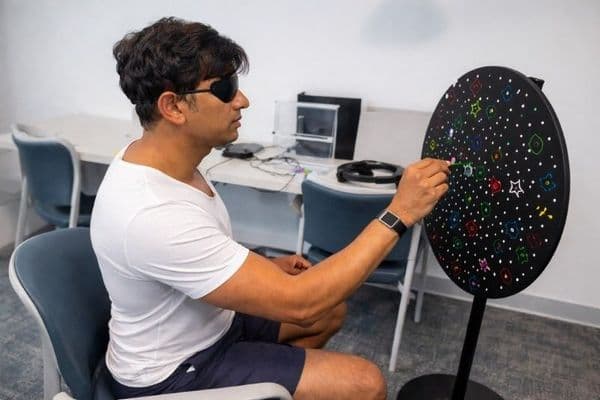
Discussion then moved on to differentials for acute onset diplopia, such as Graves’ disease, skew deviation, cranial nerve palsy and post-cataract surgery, followed by vision therapy to improve and expand the area of single clear binocular vision. Circular targets are the best to use, while anaglyphic targets tend to cancel out better than vectograms (which use polarised filters) when working with vertical deviation. Fusion targets such as vertical vectograms, digital and VR methods, free-space fusion cards and sticks and vertical fusion bar viewing exercises, often using a Marsden ball, to improve eye alignment and coordination, and free space fusion exercises, including those with a Brock string, can be adapted to include head tilts, turns and tips. This should be performed in all positions of gaze to gradually reduce compensatory prism to help build and strengthen vergence skills in various head positions and gaze directions, promoting improved binocular vision and stereopsis. Move slowly and take small steps; your aim is to increase fusion range in the correct direction by 1PD every month.
Supporting vision beyond sight
The second day of Connect25 began with ACBO president Melissa Allen announcing the launch of the ACBO Knowledge Repository, supported by Rodenstock International. The repository is a centralised, dynamic platform designed to advance clinical excellence, professional development and evidence-based behavioural optometry. It will allow ACBO members to freely access regularly updated science, research and published behavioural and neuro-developmental optometry material. Having a strong and easily accessible evidence base will help foster improved relationships with colleagues, universities, ophthalmology and other health disciplines, said Allen. “We owe it to the next generation to provide them with a solid, evidence-based foundation and believe that the knowledge repository will be a ground-breaking addition to the optometry profession in Australia and on a global level.”