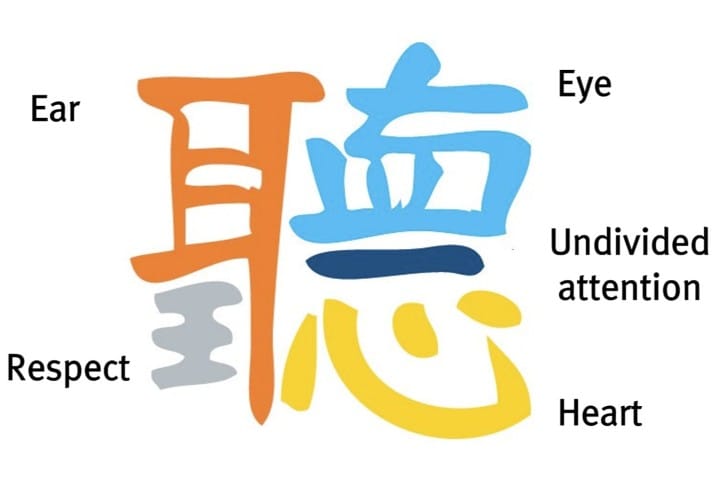
Active listening goes far beyond simply being silent while someone else talks. It’s the willingness – and the skill – to really hear and understand them. It’s a deliberate way of being present with our ears, minds and hearts, so people feel safe enough to both express themselves honestly and contemplate change.
When leaders learn to listen actively, they don’t just gather more information, they create cultures of trust where issues surface earlier, relationships deepen and people grow. Active listening doesn’t require long counselling sessions or endless airing of grievances. It’s a different way of holding the everyday conversations that happen in every workplace.
At its core, listening is an active and complex process. It requires mindfulness – hearing, noticing, making sense of what’s been communicated and responding with care. Hearing is only the starting point. True listening means holding what we’ve heard respectfully and showing that we understand.
What listening makes possible
Listening can be one of the most powerful drivers of change we have. When people feel listened to with sensitivity and genuine interest, they begin to:

Listening also changes the listener. When we make the effort to step into another’s experience, we see the world through a different lens. Our own viewpoints can soften. Listening becomes a mutual act of growth.
Why safe climates matter
To understand why active listening works, we need to consider how people form their sense of self. Each of us builds up internal pictures of who we are: some are realistic, others less so. These self‑pictures shape how we interpret feedback and experience success.
If someone quietly believes they’re not good enough, even positive feedback can feel like pressure or disbelief. Trying to ‘correct’ their view or convince them otherwise can be felt as a threat, triggering defensiveness.
Active listening takes another path. Instead of trying to change someone, we aim to understand them. When we listen without judging or moralising, people no longer experience us as ‘fixers’ but as allies. In this atmosphere – grounded in equality, care (manaakitanga) and connection (whanaungatanga) – people feel safe enough to reflect on their own stories and, if they choose, redefine them.
This is the essence of psychological safety: people can be genuine without fear of being judged or shamed. Only in that space can learning and growth truly happen.
What to avoid
When someone shares a problem, our instinct is often to jump in – to advise, reassure, praise or explain. These responses often ease our own discomfort more than theirs.
A few habits particularly block connection:
All these responses shift the focus away from the speaker’s experience and back to us, closing down the very openness we’re trying to create.
What active listeners do
Active listening is about entering another person’s world and showing, through words and attitude, that we understand. Three practices make the biggest difference:
What listening itself communicates
Listening is far from neutral – it communicates. When we listen well, our behaviour conveys powerful messages without saying a word. It says, “I value you as a person. Your thoughts and feelings matter. I’m not here to judge or fix you – I’m here to understand.”
These messages can’t be delivered through slogans or policy statements alone. They’re proven through behaviour and consistency over time. Listening, simply and quietly, is one of the strongest demonstrations of respect we can offer.
Listening also spreads. Just as frustration can ripple through a team, so can care. In workplaces, families and communities, genuine listening invites others to listen in return. Over time, communication patterns shift and those who practise listening are more likely to find their own voices heard.
The challenge and the courage
Active listening takes practice, patience and genuine curiosity. People can tell when our attention is half‑given or performative. When that happens, trust falls away.
There’s also a personal risk. When we see the world through another’s eyes, even briefly, we open ourselves to being changed by what we hear. That takes courage and humility, but it’s the essence of growth.
Real listening isn’t a trick or a tool to switch on and off. It’s a disciplined, respectful way of being with others – one that fosters learning, inclusion and connection.
When we practice it consistently, in meetings, corridors, whānau gatherings or community hui, we do more than solve problems – we model the kind of humanity our workplaces and our country need more of.

Kylie Head has more than 20 years’ experience in senior management roles across the biotechnology, diagnostics, medical laboratory, pharmaceutical, surgical and audiology sectors. She co‑chairs the Stroke Aotearoa Consumer Panel, LEAP, and contributes to several national stroke and disability advisory groups. Her company, On the Table Consulting, specialises in leadership coaching, mediation and conflict resolution, supporting people, teams and organisations across Aotearoa to build trust, clarity and connection. onthetable.co.nz