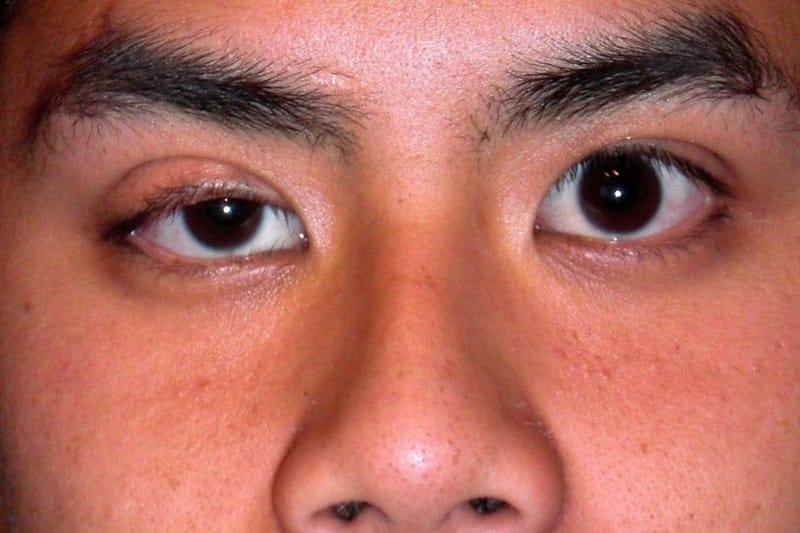
Ptosis is one of those conditions that seems simple until you try to measure it properly. In clinic, between the millimetre ruler, patients shifting their eyes, a lid that twitches at the worst moment and the clinician leaning uncomfortably close to the patient’s eye, the process is far from easy.
Metrics such as margin reflex distance 1 (MRD-1) and palpebral fissure height are essential, but they are also deeply dependent on examiner skill, patient cooperation and lighting. For anxious patients, children or those who dislike close contact, it can be a difficult experience. For clinicians, it is often inconsistent, especially taking measurements over time or between different examiners.
So the question has been hiding in plain sight: why are we doing this manually?
The idea for an alternative solution surfaced at the end of a long oculoplastics clinic, when Dr Cam Loveridge-Easther showed me something he had mocked up using ChatGPT. It was disarmingly simple. The iris is close to a perfect circle. Eyelids obscure predictable arcs of that circle. Therefore, in theory, a computer should be able to measure ptosis from a single photograph by calculating how much of the iris is exposed.
That was the moment the IRIS project began. We decided to test the concept with a small pilot model built in Google Colab, which provides access to GPU (graphics processing unit) computing power for deep learning. My initial instinct was to approach the problem mathematically: treat the pupil as a centre point, fire ‘starburst’ rays outward, detect where they hit the iris or eyelid margins and calculate the amount of obstruction geometrically.