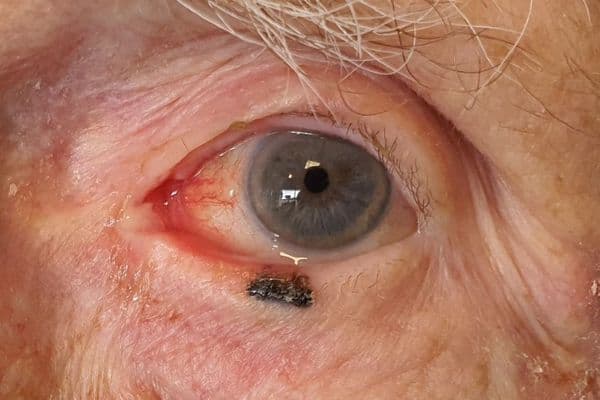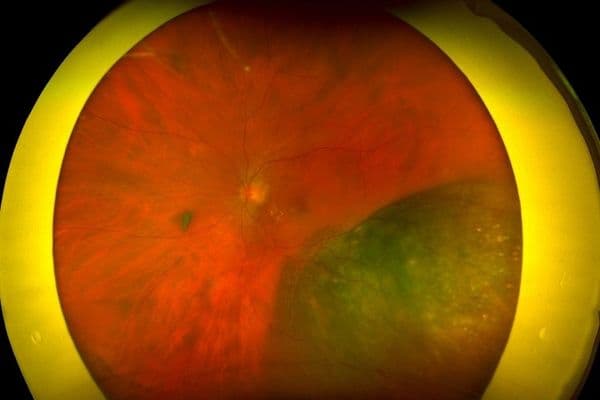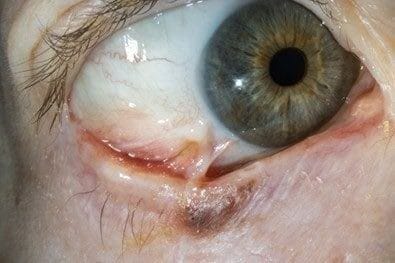
Ocular tumours are rare but carry significant consequences. Choroidal melanoma occurs in approximately 6–10 per million people per year, with iris and conjunctival melanomas even less common at around 1 and 0.5 per million respectively1. These malignancies most commonly affect middle-aged and older individuals, particularly those with fair skin and light-coloured irides. While anterior tumours are often detected earlier, posterior lesions frequently remain asymptomatic and are therefore at greater risk of delayed diagnosis.
Although these conditions are uncommon and best managed in subspecialist centres, for both optometrists and ophthalmologists, early recognition and referral remain key to improving outcomes.
Conjunctival melanoma
Conjunctival melanoma is uncommon and most pigmented conjunctival lesions encountered in practice are benign. Conjunctival naevi are the most common and typically present in the first two decades of life within the interpalpebral fissure. They often contain cysts, may enlarge slowly and generally do not require treatment. Racial melanosis presents as diffuse pigmentation in individuals with darker skin types and carries low malignant potential.
New or changing conjunctival pigmentation, particularly if nodular, irregular, vascularised or located in high-risk areas such as the plica, caruncle or fornices, should raise suspicion for conjunctival melanoma and prompt referral2.


.jpg&w=1920&q=75)