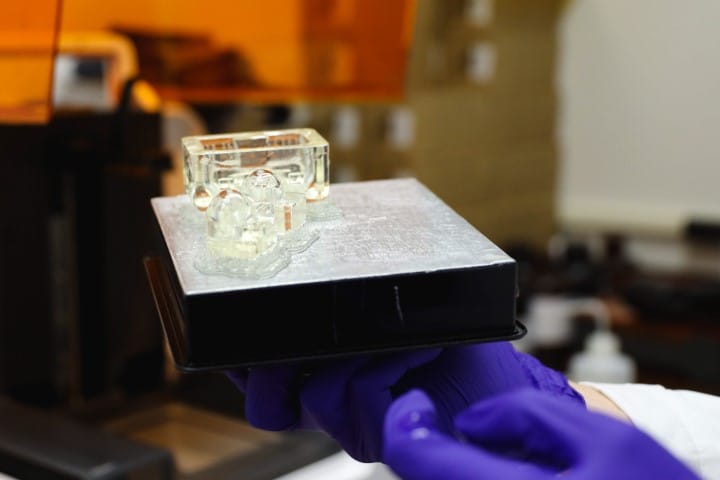
Presenting at ARVO 2023, researchers from Canada’s Centre for Ocular Research & Education (CORE) presented on 3D printing of polydimethyl siloxane (PDMS) microfluidic chips to test ocular cellular responses to various conditions, formulations and materials and evaluate contact lens-based drug release. Human corneal epithelial cells were also incorporated, showing strong adherence, metabolic activity and growth capability, indicating the viability of chip-based cell studies, they said.
CORE’s presentation also described a soft hydrogel eye model to evaluate ocular drug delivery which includes an upper and lower eyelid, a ‘cornea’ and ‘sclera’ and an internal chamber to mimic the interior of the eye. The eyeball and the lower eyelid were 3D bioprinted then fitted with CORE’s OcuBlink device for automated blinking and tear collection, they said.
Dr Alex Hui, CORE’s head of biosciences, said the team has created one of the most sophisticated 3D printing environments for ocular research in the world, having previously shared multiple 3D printing advancements for drug delivery systems and biodegradable contact lenses.