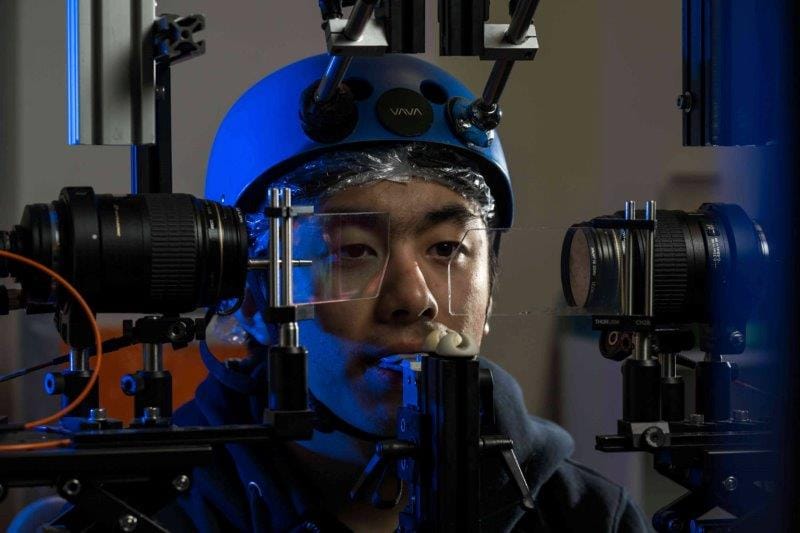
In a newly published report in the Proceedings of the National Academy of Sciences, a US research team claims blinking not only protects against dry eyes, but also helps people process visual information more effectively.
Humans spend about 3-8% of their waking hours with their eyes closed, which suggested there might be additional functions beyond lubrication, said researchers from the University of Rochester. The team tracked eye movements in human observers and combined the data with computer models and spectral analysis to study how blinking affects what the eyes see when our eyelids are open and closed, including how sensitive we are at perceiving different types of stimuli.
When people blink, they become better at noticing big, gradually changing patterns providing more information to the brain about the overall visual scene, said Professor Michele Rucci from the Department of Brain and Cognitive Sciences. “By modulating the visual input to the retina, blinks effectively reformat visual information, yielding luminance signals that differ drastically from those normally experienced when we look at a point in the scene. The results show that when we blink, the rapid motion of the eyelid alters the light patterns that are effective in stimulating the retina. This creates a different kind of visual signal for our brain compared to when our eyes are open and focused on a specific point.”