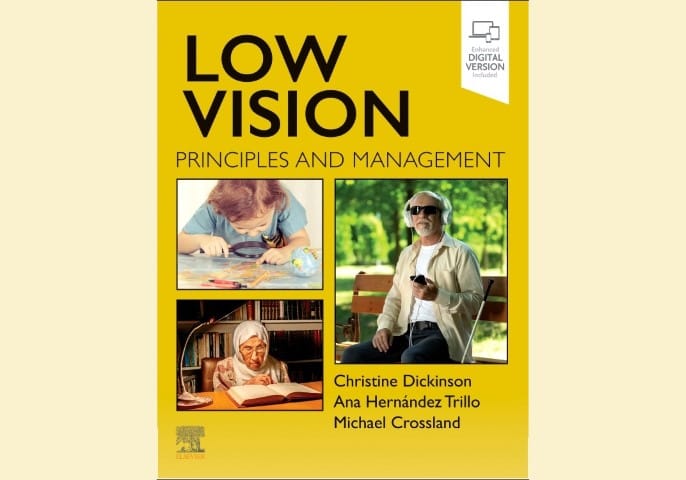
The authors, from Manchester University and Moorfields Eye Hospital’s Low Vision Clinic, UK, say that since this diverse topic spans ocular pathology, epidemiology, lighting, optical design, psychological adaptation and devices for sensory substitution, a general grounding in optometric and ophthalmological topics is assumed. Disease knowledge also allows the likely impairment to be anticipated, which helps in targeting questions about activity limitations.
Following the table of contents (helpfully divided into five parts, with each part divided into chapter subheadings), Low Vision’s authors launch into defining their subject, which is no mean feat. Instead of traditional definitions based on visual acuity on the distance chart, they characterise low vision in terms of visual impairment, activity limitations and participation restriction. They recommend thinking in terms of consequences to the bodily organ affected (the impairment), the consequences to the patient in terms of their abilities (activity limitation) and their interaction with the society they live in (participation restriction), with the aim of preventing activity limitation and participation restriction. Framing low vision this way lays bare the inadequacies of using the ubiquitous ‘legally blind’ label, which exists only to prevent benefit fraud.
A pragmatic view of visual performance testing is also highlighted by the statement that, “It should be emphasised that in the context of a low-vision clinic, tests with high diagnostic accuracy are not necessary: the aim is to discover whether there are functional consequences of a defect”. This reinforces the need to speedily gather enough information for the practitioner to be proactive about reducing activity limitations before the patient is fatigued and/or loses interest.