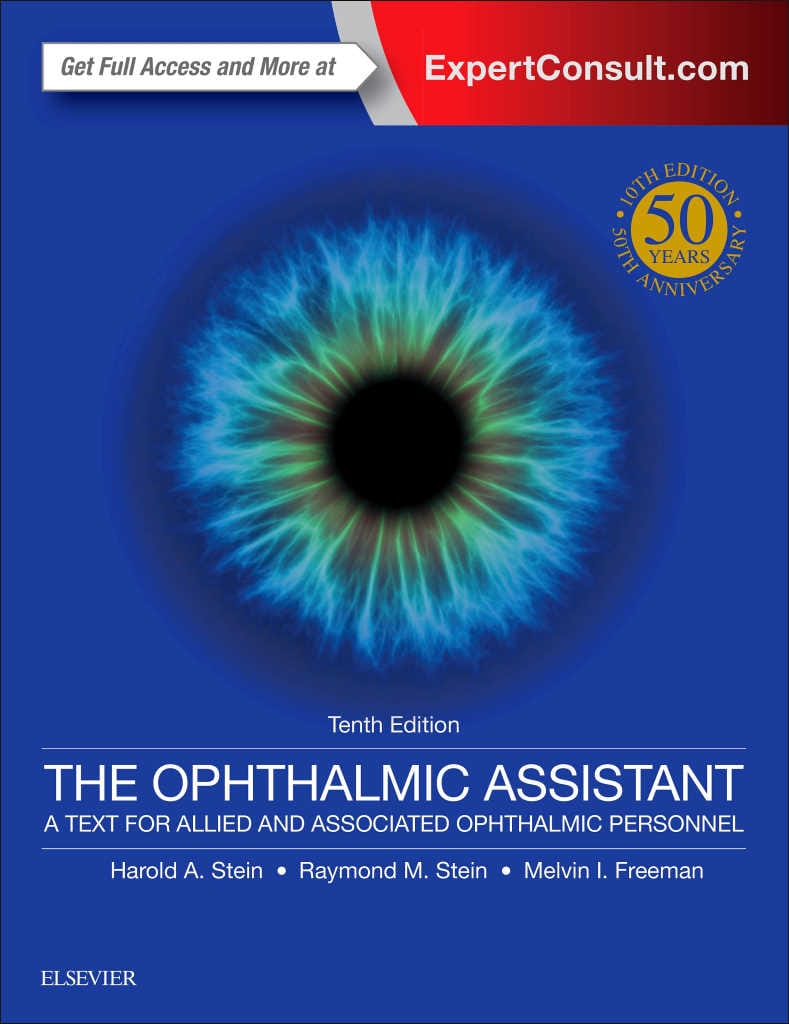
By Harold Stein, Raymond Stein and Melvin Freeman. Published by Elsevier, 2017
Much has changed in ophthalmology since the publication of the first edition of ‘The Ophthalmic Assistant’ almost 50 years ago. In an era before the internet and Wikipedia, resources for a quick reference were scarce. The first edition was published in 1968 to fill the gap and act as a ‘go-to guide’ for technicians, allied health professionals and physician assistants, or PAs as they are addressed in the US. Subsequent editions have expanded into different areas of eye care delivery with expansive colour illustrations for a quick grasp of content. The 10th edition by Harold Stein, Raymond Stein and Levin Freeman promises to continue that five-decade tradition with a few added chapters and some interesting surprises.
The 900-page book has 10 sections, covering the basics of clinical practice, common clinical eye problems and refractive error to ocular imaging and a brief atlas of clinical ophthalmic disorders. The order of sections and chapters is logical and clear.
The first couple of sections briefly introduce readers to ocular anatomy and physiology. This is followed by a more in-depth look at history taking, refractive error, spectacles and, importantly, contact lenses. Four chapters in total have been aptly dedicated to contact lenses, covering fitting, management and its complications. However, these four chapters are still just a mere introduction to contact lenses if one wishes to master the topic.
The addition of a separate chapter on dry eye is timely since the Dry Eye Workshop II (DEWS II) report was released earlier this year. The chapter briefly discusses novel diagnostic techniques which have emerged over the past few years. This is crucial since dry eye disease is now recognised as a chronic problem with a wide range of complications by an increasing number of eye care professionals. Another important chapter covers refractive surgery, given its growing popularity over the past decade. LASIK, LASEK, PRK, plus bifocal implants and other surgical techniques to correct presbyopia, are discussed. Notably, there is also a chapter on recent technological advances including ocular coherence tomography (OCT), computerised corneal topography and specular microscopy.