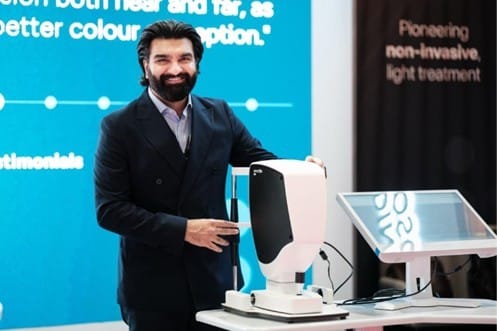
The developer of Revisyon, a light-based device designed to treat early cataracts, has responded to New Zealand eyecare professionals’ concerns about its safety and effectiveness.
Developed by Edinburgh Biosciences, Revisyon uses specific wavelengths of low-intensity light to trigger chemical changes in lens proteins. The aim is to restore those proteins’ natural structure, reducing light scatter and improving vision. The company said this process allows light to pass through the lens more clearly, resulting in brighter, sharper vision.
However, the technology has drawn scepticism from clinicians. In October 2025, Hamilton surgeon Associate Professor James McKelvie said, “At best, it may be a temporary solution that could be very expensive,” and questioned the company’s comparisons with cataract surgery at the time, describing some as “incorrect or overstated”. Dr Peter Hadden also raised concerns about the underlying science, noting that light below 320nm, which has sufficient energy to alter molecules, cannot pass through the cornea. “If used, such light could risk DNA mutations and cancer,” he warned.
Responding to these criticisms, Edinburgh Biosciences chief commercial officer (CCO) Alok Machchhar said the company welcomes inquiry. “We recognise that innovative approaches in eyecare naturally attract questions and scrutiny, particularly when the clinical data have not yet been published,” he said.
He stressed that Revisyon is not intended to replace cataract surgery. “Rather, it is being developed as a non-invasive treatment option for patients earlier in the cataract pathway, particularly those who are not yet ready for surgery.”