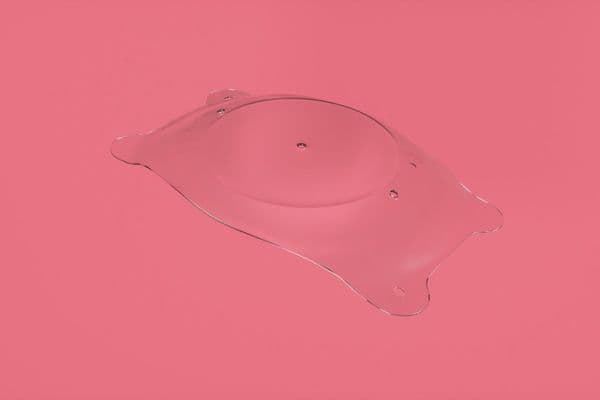
Inspired by tiny nanostructures on transparent butterfly wings, engineers at the California Institute of Technology (Caltech) have developed a synthetic analogue for eye implants that makes them more effective and longer-lasting.
Sections of the wings of a longtail glasswing butterfly are almost perfectly transparent. Three years ago, Caltech postdoctoral researcher Radwanul Hasan Siddique—at the time working on a dissertation involving a glasswing species at Karlsruhe Institute of Technology in Germany—discovered the reason why: the see-through sections of the wings are coated in tiny pillars, each about 100 nanometers in diameter and spaced about 150 nanometers apart. The size of these pillars—50 to 100 times smaller than the width of a human hair—gives them unusual optical properties. The pillars redirect the light that strikes the wings so that the rays pass through regardless of the original angle at which they hit the wings. As a result, there is almost no reflection of the light from the wing's surface.
In effect, the pillars make the wings clearer than if they were made of just plain glass.
That redirection property, known as angle-independent antireflection, attracted the attention of Caltech's assistant professor Hyuck Choo. For the last few years Choo has been developing an eye implant that would improve the monitoring of intra-eye pressure in glaucoma patients. "Right now, eye pressure is typically measured just a couple times a year in a doctor's office. Glaucoma patients need a way to measure their eye pressure easily and regularly," says Choo.
Choo has developed an eye implant shaped like a tiny drum, the width of a few strands of hair. When inserted into an eye, its surface flexes with increasing eye pressure, narrowing the depth of the cavity inside the drum. That depth can be measured by a handheld reader, giving a direct measurement of how much pressure the implant is under.