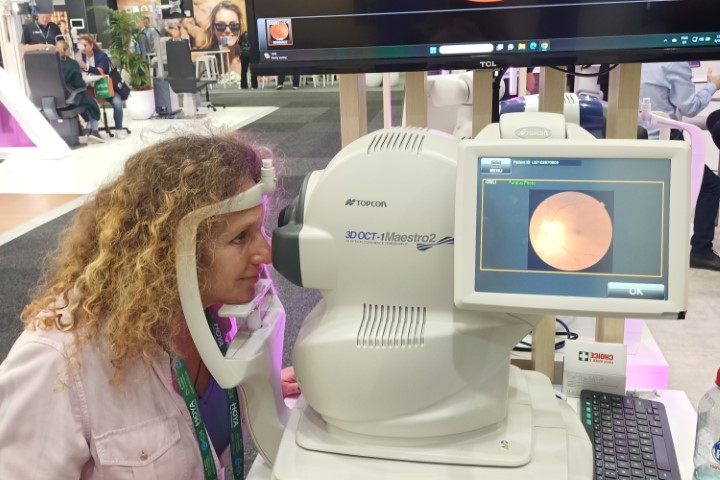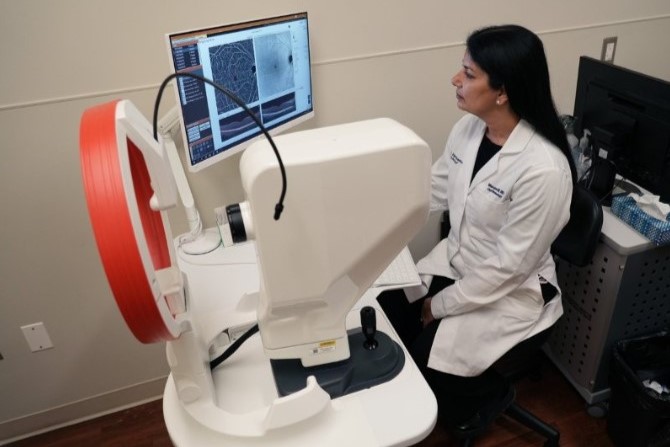








Researchers found combining optical coherence tomography (OCT) and OCT angiography (OCTA) not only enhances discrimination between people with mild cognitive impairment (MCI), probable Alzheimer’s disease (AD) or no cognitive impairment, but is more accurate than either modality alone.
Published in Alzheimer’s Research & Therapy, the cross-sectional study was led by the Singapore Eye Research Institute and included 196 memory clinic participants. Of these, 60 had no cognitive impairment, 83 had MCI and 53 had probable AD. Investigators used OCT and OCTA to assess retinal layer thickness and microvascular metrics.
In patients with MCI or probable AD, the inner nuclear layer and inner segment/outer segment layers were significantly thicker, while the outer nuclear layer was significantly thinner in MCI or probable AD participants compared with controls, said researchers. “OCTA showed reduced vessel densities in the superficial and deep capillary plexuses, along with a larger deep foveal avascular zone perimeter in MCI or AD.”
Individually, OCT and OCTA layers showed moderate diagnostic performance in distinguishing cognitive impairment from normal cognition, but when metrics from both imaging modalities were combined, diagnostic accuracy improved markedly, the study showed. The combined OCT/OCTA approach yielded an area under the receiver operating characteristic curve of 0.90 with 81% sensitivity and 87% specificity.
Integrating OCT- and OCTA-derived metrics significantly improved discriminative performance compared with either modality alone, said authors. “[This underscores] their complementary value in capturing distinct structural and vascular alterations associated with cognitive impairment.”