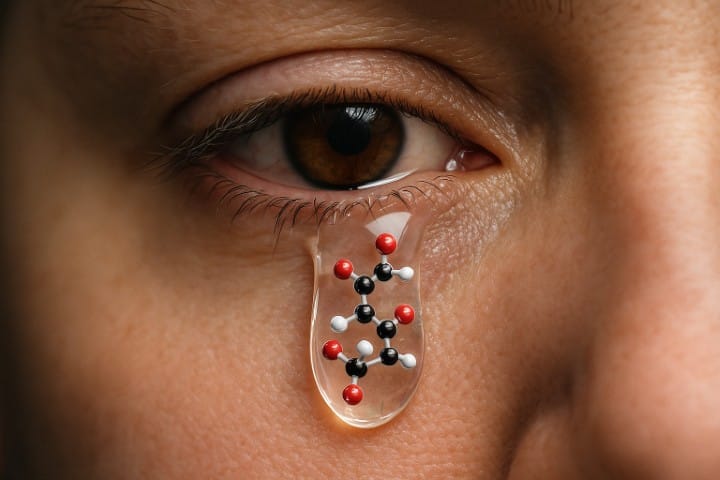
New Zealand researchers are investigating tear-film signatures that may help early diagnosis of Parkinson’s and Alzheimer’s disease.
Their work – described in Auckland’s Neurological Foundation report – has shown clear differences in the aggregation of the protein alpha-synuclein (aSyn) in the tears of people with Parkinson’s compared with age-matched controls. Misfolded aSyn forms toxic clumps called Lewy bodies, a hallmark of Parkinson’s disease and Lewy-body dementia. “Misfolding means that the protein no longer functions normally and encourages more ‘normal’ protein to also misfold and indeed propagate across neurons, causing a spread of injury across the brain,” said project lead Canterbury University neuropsychologist Professor Dalrymple-Alford.
The researchers, who also included Otago University neurologist Professor Tim Anderson and Auckland University’s Associate Professor Stuti Misra, reported that tear collection was strongly preferred by participants over venous or cerebrospinal fluid (CSF) sampling, highlighting its potential as a practical diagnostic medium. “You’ll get a few tears if you collect my CSF, but could we just start with the tears first?” said one study participant. Their findings have prompted further comparison with Alzheimer’s to identify overlapping and disease-specific signatures.