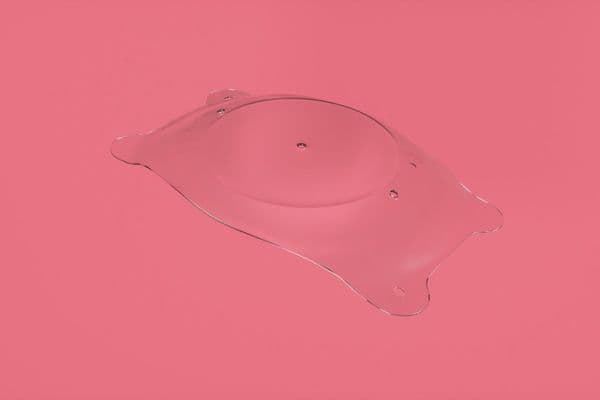
Researchers from the Centre for Eye Research Australia (CERA) and the University of Melbourne have received a funding boost to fast-track the development of their new medical device CorGel, an ultra-thin hydrogel film used to insert donor corneal tissue into a patient’s eye to restore vision.
The A$500,000 Victorian Medical Research Acceleration Fund grant will contribute to 18 months of preclinical work to refine and test CorGel, said Professor Mark Daniell, CERA’s principal investigator for corneal research in a CERA news article. “Our goal at the end of this 18 months is to get CorGel into a clinical trial and do the first human study.”
Current corneal transplant techniques focus on replacing the damaged area of the cornea rather than the cornea in its entirety leading to quicker recovery, better results and minimal rejection. This includes Descemet’s membrane endothelial keratoplasty (DMEK), when the damage is limited to the innermost layer of the eye, the endothelium. However, performing DMEK surgery can be very difficult, explained Prof Daniell. “Rather than transplant the whole cornea, we’ve taken just a single layer of cells from the donor, with some of the Descemet’s membrane on the back. And this graft membrane tends to scroll up when we insert it into the eye.”
Unscrolling the delicate graft membrane without damaging it is technically difficult, which reduces the chance of successful surgery, resulting in many ophthalmologists selecting other surgical procedures which aren’t as effective, he said.
This is where the CorGel device has the potential to be a game changer, said Prof Daniell. “Its key feature is that it keeps the donor corneal tissue flat when it is inserted into the eye. Donor corneal endothelium is stuck to the CorGel film scaffold, using a light-activated bio-glue, and inserted into the back of the eye. The film is made from the same material as pill capsules – PEG or polyethylene glycol – which dissolves into non-toxic by-products within a few weeks. By that stage the cells will have attached and started to work as a corneal transplant.”