Children’s brains compensate after brain surgery for epilepsy, to keep full visual perception, according to a study funded by the US National Eye Institute (NEI).
While brain surgery can halt seizures, it carries significant risks including impairment in visual perception. Carnegie Mellon University, Pittsburgh, researchers say their study shows the lasting effects on visual perception can be minimal, even among children who lost tissue in the brain’s visual centers.
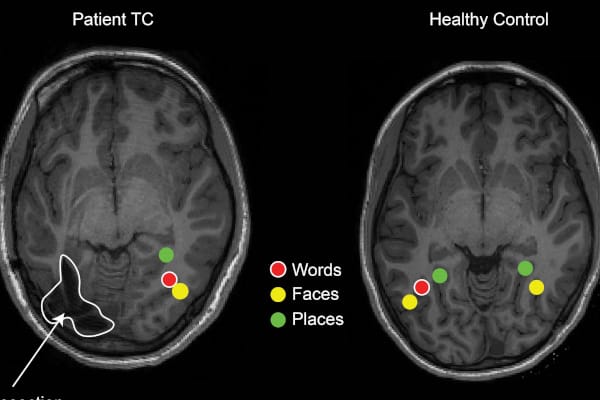
Normal visual function requires not just information sent from the eye (sight), but also processing in the brain to understand and act on that information (perception). Signals from the eye are first processed in the early visual cortex. They then travel through other parts of the cerebral cortex, enabling recognition of patterns, faces, objects, scenes, and written words. In adults, even if their sight is still present, injury or removal of even a small area of the brain’s vision processing centers can lead to dramatic, permanent loss of perception, making them unable to recognise faces, locations, or to read, for example. But in children, who are still developing, this part of the brain appears able to rewire itself, a process known as plasticity.
Dr Marlene Behrmann and colleagues recruited 10 children who had undergone surgery for severe epilepsy and 10 matched healthy children. Of the six children who had areas of the visual cortex removed, four had permanent reductions in peripheral vision on one side due to loss of the early visual cortex. The epilepsy was resolved or significantly improved in all children after surgery.
The researchers tested the children’s perception abilities, including facial recognition, the ability to classify objects, reading, and pattern recognition. Despite in some cases completely lacking one side of the visual cortex, nearly all the children were able to successfully complete these behavioral tasks, falling within the normal range even for complex perception and memory activities.