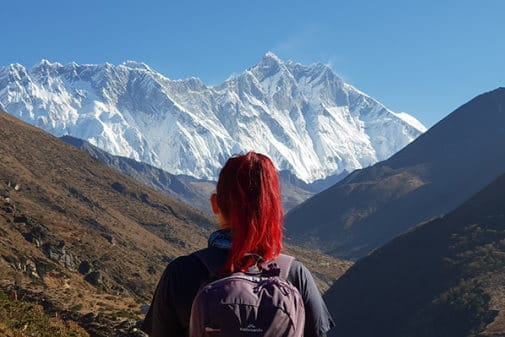
If you’d told me 18 months ago I’d be on a plane returning home from three weeks volunteering on Mount Everest, I would have thought you were crazy. Thankfully, I was fortunate enough to be the winner of a Specsavers-sponsored trip with Eyes4Everest, a charity set up in 2014 to treat preventable blindness in Nepal.
Little did I know what a challenging and impactful journey lay ahead.
With the support of Eyes4Everest’s local team, who kindly doubled as translators, guides, pre-testers and organisers, we visited three towns, Phakding, Phortse and Pangboche, each with its own mix of lovely people and unique challenges. Using a binocular indirect ophthalmoscope and a handheld slit lamp, we were able to assess and refer patients with cataracts, pterygiums, diabetic retinopathy and more. We saw a significant amount of dry and itchy eyes, so our lubrication and anti-histamine drops were also well received.
Professionally, we faced a number of challenges, including language barriers and a lack of power and equipment. Our biggest advantage, however, was the kind and patient nature of the Sherpa people. With patients coming from near and far to see us - some had walked for more than two hours – we often tested into the dark, but everyone was happy to wait, all with big smiles. Testing even became a group event, with locals helping their friends guess the symbols on our charts. We also greatly appreciated the younger patients who often hung around after their own tests to help translate for our older patients. Glasses were ordered as needed and distributed by the local team a few weeks after our departure, but for more serious conditions it wasn’t so simple. Referrals were easily made to Kathmandu Hospital, but the 30-minute flight is financially out of the question for most, meaning an overland journey of 10 days or more for our more serious patients.
On a personal level, this trip pushed me physically (70+ hours of hiking) and mentally more than I anticipated. It also reinforced the knowledge of how privileged we are in New Zealand and the positive difference we can make to others on a day-to-day level if we so choose. I became an optometrist to make a difference to people’s quality of life and Eyes4Everest's goal of bringing eyecare to those who wouldn’t have access to it otherwise aligns perfectly with that.