Clinically, dry eye has been broadly classified into two main subtypes: aqueous-deficient and evaporative1. Aqueous-deficient dry eye is characterised by reduced aqueous tear production2 and is often accompanied by ocular surface inflammation3,4. Evaporative dry eye is defined by excessive tear film evaporation, frequently due to tear lipid abnormalities associated with meibomian gland dysfunction5. However, the extent to which inflammation contributes to an individual patient’s dry eye presentation, particularly in cases of mixed aqueous-deficient/evaporative disease, can be challenging to quantify in the clinic.
Bulbar conjunctival hyperaemia can provide a gross, non-specific indication of ocular surface inflammation. Point-of-care testing for elevated levels of matrix metalloproteinase-9 (MMP-9) can identify threshold levels of this pro-inflammatory enzyme in tears, but this immunoassay is not broadly accessible. As such, it can be difficult for a clinician to confidently determine the appropriateness of instituting anti-inflammatory therapy.
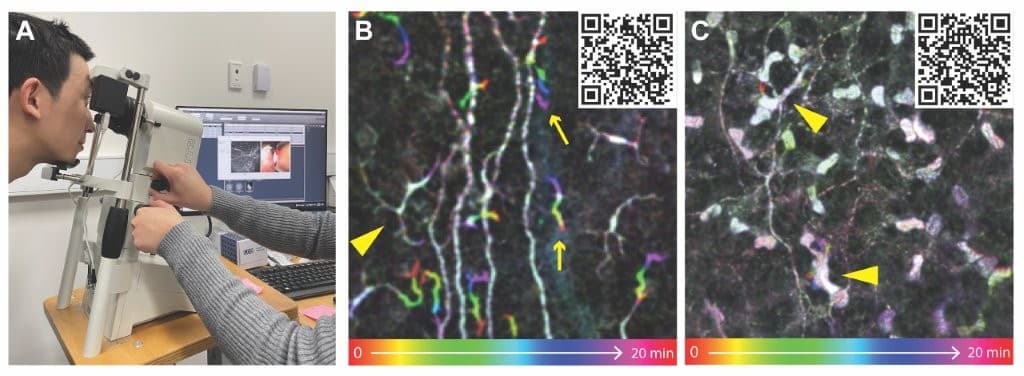
In vivo confocal microscopy (IVCM), using the Heidelberg Retinal Tomograph-3 with Rostock Corneal Module, is a clinical technique enabling high-resolution imaging of immune cells in the human cornea7. The presence of inflammation in dry eye disease (DED) has previously been evaluated using this technique, with subsequent analysis of immune cells from static IVCM images. Individuals with aqueous-deficient dry eye have been found to have a higher corneal immune cell density than healthy controls8-10. Dry eye severity has been linked to differences in immune cell shape and morphology, suggestive of alterations to cell activation state and/or function11. However, as static IVCM imaging captures only one snapshot in time, it has limited ability to reliably differentiate subsets of corneal immune cells and cannot be used to evaluate cell behaviours. Assessment of these features, to better define inflammatory responses in the cornea, requires consideration of both a cell’s morphology and dynamic movement.