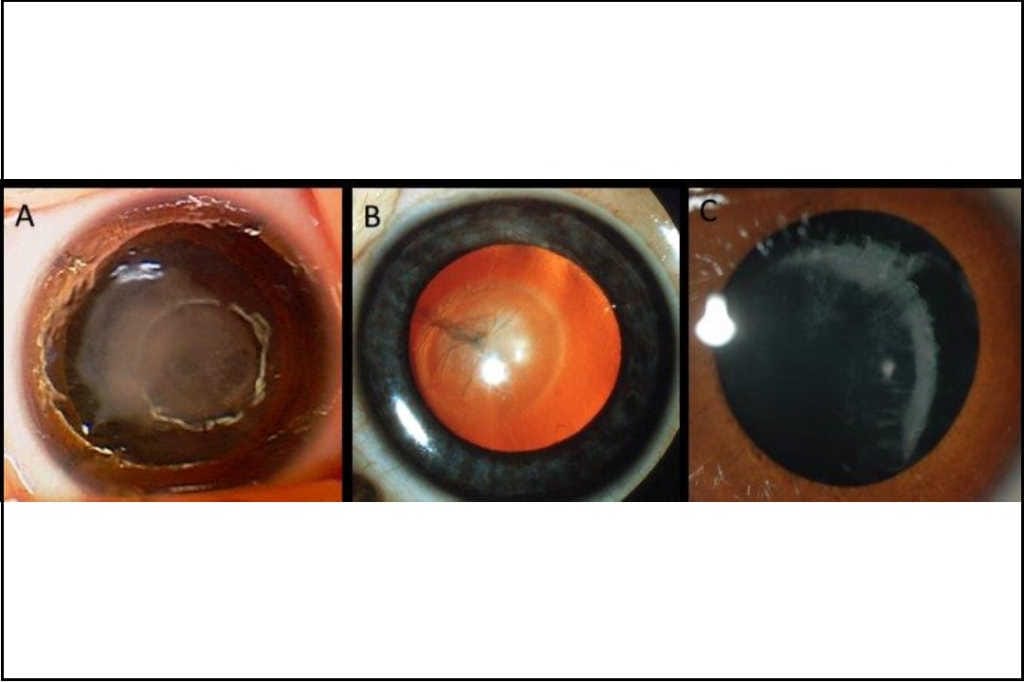
Congenital cataract typically presents in infancy with variable lens opacities that block the normal red reflex (Fig 1). It can be associated with other ocular and systemic abnormalities. There may be a family history of cataract and the inherited forms are typically autosomal dominant. Diagnosing the cause of the cataract benefits the patient in understanding risk to other family members as well as risk of systemic associations. Our approach to the investigation of these patients has evolved to include next-generation sequencing (NGS) gene panel investigation.

Clinical presentation of congenital cataract
Congenital cataract affects approximately 2.2 per 10,000 births and causes 6.1% of low vision and 4.1% of blindness in children in New Zealand1,2. Presentations vary but the national red reflex screening checks at birth and at six weeks are the optimal times to identify congenital cataract. Early identification and surgical management are key in preventing dense and irreversible sensory deprivation amblyopia. Ideally, for dense unilateral cataracts, surgery and optical correction are performed between six and eight weeks of life and for bilateral cataracts between six and 10 weeks of life3. Surgery earlier than this is associated with an unacceptable glaucoma risk, which nevertheless remains at around 10-25% lifelong.
For the majority of babies, our practice in New Zealand is to avoid intraocular lenses under one year of age and often under two years of age as the evidence shows equal visual outcomes with less complications4. There is no protective effect from intraocular lens implantation on glaucoma risk. Post-operatively babies are optically managed with extended-wear contact lenses, with parents taught how to remove and clean them once a week (Fig 2).