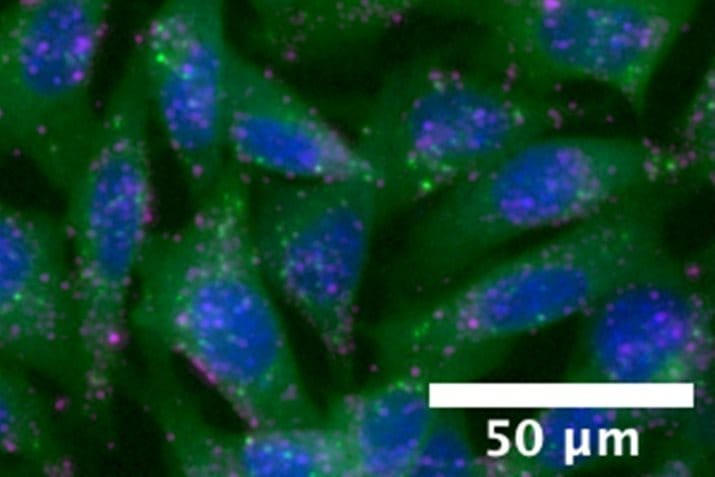
A team from US-based Johns Hopkins University have developed a colour-coded test that quickly signals whether therapeutic nanoparticles (NPs) have delivered their cargo into target cells, in the fight against cancer and eye disease, and in vaccines for viruses including SARS-CoV-2.
“Many of the current assessment tools for nanoparticles only test whether a nanoparticle reaches a cell, not if the therapy can successfully escape the degradative environment of the endosome to reach inside the cytosol of the cell, which is where the medicine needs to be located for performance,” said Professor Jordan Green, biomedical engineer at Johns Hopkins School of Medicine. Previous research has shown that only about 1-2% of nanoparticles taken up by cells are able to escape the cellular compartments that trap them to avoid being digested or rejected. This new imaging-based screening platform requires only wide-field epifluorescence microscopy to simultaneously assess the cellular internalisation and endosomal disruption capabilities of nucleic acid delivery NPs, said Prof Green.
The test uses mouse cells grown in the laboratory that are genetically engineered to carry a florescent marker called Gal8-mRuby, which shines orange-red when a cellular envelope that engulfs a nanoparticle opens, releasing its cargo into the cell. A computer programme quickly tracks the nanoparticle location using red fluorescent light and quantifies how effective the nanoparticles are at being released into the cell by assessing the amount of orange-red fluorescent light.