I was privileged to attend the 38th ANZ Cornea Society and Eye Bank Meeting in Perth, the first in-person meeting since 2020, together with New Zealand’s National Eye Bank team, including director Dr James McKelvie and Dr Bia Kim, a senior anterior segment fellow at Te Whatu Ora Auckland. As well as covering advances in corneal surgery, this year’s meeting was also an opportunity to update surgeons and eye bank members on the trend changes for corneal tissue use in surgery and tissue donation post-Covid. It was an illuminating glimpse into the intricacies of eye bank coordination in the fight against blindness.
Erik Hellier, director of global development for Eversight, a US network of non-profit eye banks, outlined the company’s difficulties in sourcing corneal tissue overseas. Hellier was involved in setting up a South Korean eye bank to create a more central hub to distribute tissue farther. He noted the criteria for tissue donation had become stricter with the introduction of further tissue testing, including for syphilis. Compounding the issue, the high cost of manufacture and company insolvencies in the wake of Covid led to limited supplies of tissue-storage media.
Expanding on Hellier’s concerns, Pierre Georges, coordination team leader at Lions NSW Eye Bank, discussed a recent study showing the lack of conversation about eye tissue donation by optometrists and ophthalmologists. Although most eyecare professionals said they were comfortable talking about the subject when raised, it didn’t always feel appropriate or they hadn’t enough consulting time, he said. Patient factors included family refusing donation, a lack of knowledge about donation and not wanting to donate eyes specifically. It was pointed out that some willing potential donors and their families were incorrectly told by a hospital doctor they were not candidates, based on their other organs’ unsuitability for donation.
Shifting graft trends, increasing demand
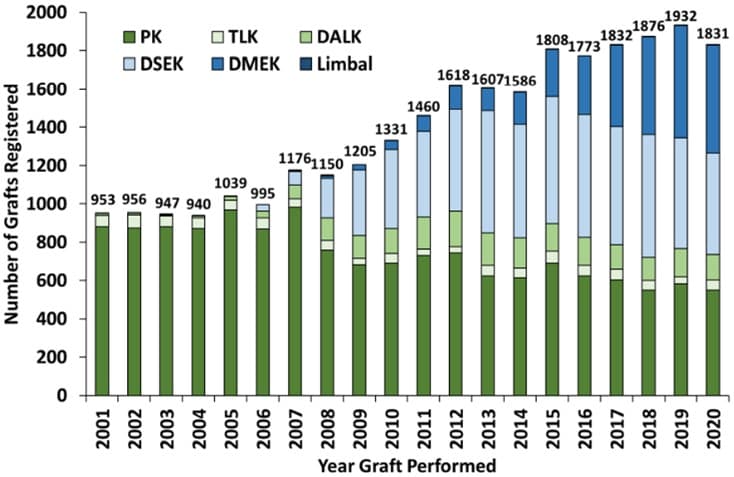
Dr Miriam Keane, executive director of the Australian Corneal Graft Registry (ACGR), discussed the changing trends of the last two decades. Unsurprisingly, there has been an increase in endothelial keratoplasties, with Descemet's stripping (automated) endothelial keratoplasty, Descemet's membrane endothelial keratoplasty and penetrating keratoplasty having roughly equal numbers performed in 2020. As the region recovers from Covid, ACGR is expecting the demand for grafts to increase in 2023, she said.