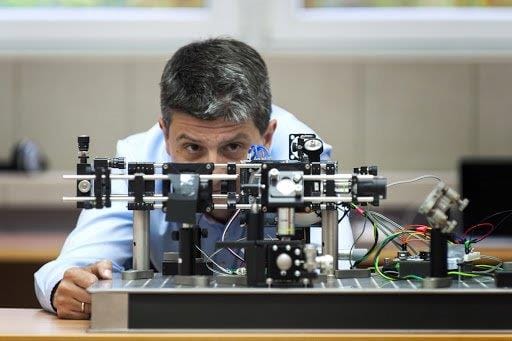
Researchers at the Institute of Physical Chemistry of the Polish Academy of Sciences (IPC PAS) have found a way to scan the depth of the cornea at unprecedented resolutions, quicker than a patient can blink.
Their new holographic optical coherence tomography (OCT) scanning technology is so accurate that even single cells can be viewed, researchers told News Medical. Key to its success is the disruption of spatial coherence of the swept laser source (using a fast-deformable membrane), keeping the exposure of tissue within safe limits. It requires no physical contact with the patient and therefore no anaesthesia, and with a field of view of 615µm × 615µm recorded in just 8.6ms, the blurring from eye movement usually associated with OCT is negated.
The high-contrast, high-resolution imaging can scan various corneal layers, such as the epithelium, stroma and endothelium; sub-basal and middle stroma nerves can also be seen, said Professor Maciej Wojtkowski, lead author and head of IPC PAS. “Moreover, our new device has no moving parts, and thanks to the phase modulation of the laser beam we can use more power without harming deeper tissues of the eye."
It could revolutionise the diagnosis of eye diseases, giving doctors a new tool to examine patients quickly and painlessly, he said.