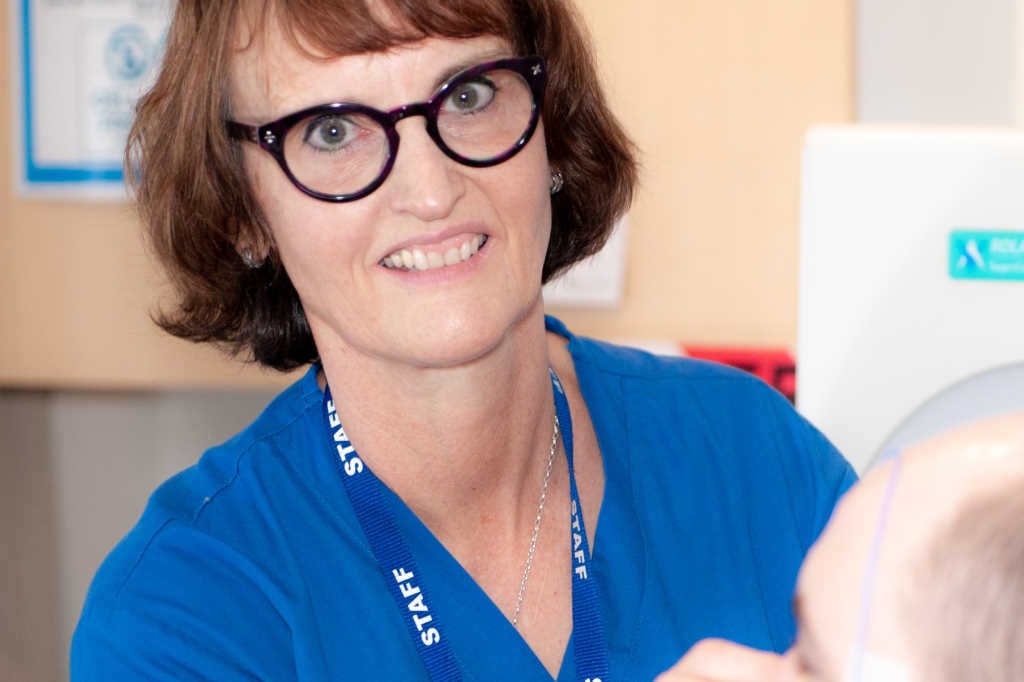
A former dispensing optician, Juliet Ware is Auckland’s only ophthalmic electrodiagnostic technician working in the public healthcare setting. She is based in Greenlane Clinical Centre’s ophthalmology department.
Serendipity put Ware on the path to visual electrodiagnostics*. “I was working crazy retail hours, managing and dispensing at a large OPSM branch. I then did some optical repping to get out of the retail environment, which required a lot of out-of-town travel.” Ready for a change, Ware learned from her neighbour, a Greenlane eye clinic nurse, that they had an opening for a trainee ophthalmic electrodiagnostic technician. “I decided to apply, even though I didn’t really know what it was about. Here I am, over 10 years later!”
Retraining on the job had its challenges, electrodiagnostics being completely different to optics, she said. “I was very lucky as I trained under Dr Dianne Sharp, although she must have torn her hair out in despair. Dr Sharp is one smart cookie, but she really explained stuff to me in a way I could understand.”
Ware sees three to six patients a day, with tests typically taking between 30 and 60 minutes each, with many patients requiring a combination of tests to give complete information about their visual problem, she explained. While most have either retinal or optic nerve issues, she said roughly a third of patients require toxicity monitoring as they are on hydroxychloroquine, prescribed mainly for lupus and rheumatoid arthritis.
A challenging aspect of the role is performing tests such as an electroretinogram, which require electrodes placed around the face and in the eyes. This can be extremely difficult with young children and babies as they don’t understand what’s going on, Ware said. “Sometimes, as a last resort with an uncooperative child, we end up performing the test in theatre under general anaesthetic.”