Globally, eye health professionals have been discussing the rise of myopia for decades. Some believe it’s the next epidemic resulting from our changing lifestyles, while others cite a lack of access to eyecare services and health literacy for its increasing prevalence. In New Zealand, a nation that celebrates the great outdoors, but which has a vague picture of the state of its national eye health, Specsavers has examined how myopia is trending.
In early 2023, Specsavers reviewed its de-identified patient records from across Aotearoa to gain a better understanding of myopia prevalence among children presenting to optometrists and how those data compared to other countries. Our ambition was to improve our evidence-based strategy for providing the best care to patients with myopia and to better integrate the tools needed to assist optometrists to manage and treat patients. We used the International Myopia Institute’s definition of a spherical equivalent refraction ≤-0.50D in one or both eyes, with high myopia being ≤-6.00D.
Results
In the five-year period from 2017-2022, 507,292 patients aged 18 years and younger received eyecare services from Specsavers’ 58 New Zealand practices. In this timeframe, although volumes increased, the rate of myopia remained relatively stable, with 32.6% of patients presenting as myopic in 2017 and 29.8% in 2022. Interestingly, the average age of first diagnosis was 14.2 years in 2017 and 13.2 years in 2022. Myopia prevalence also varied by region, with 32.5% of North Island children having a myopic prescription compared to only 25.9% in the South Island.
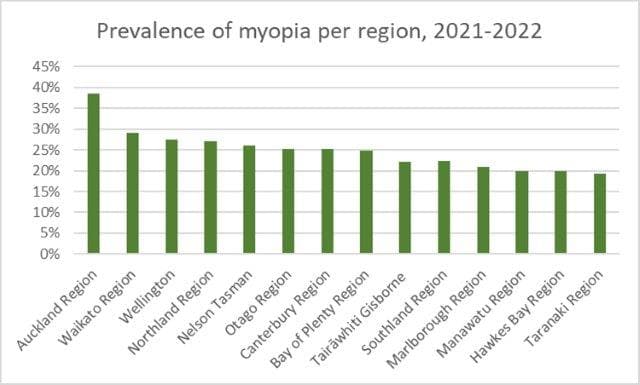
A smaller subset of data allowed us to break down the prevalence by region (see graph). From November 2021-October 2022, myopia was most prevalent in Auckland (39% of patients aged 18 years and under) followed by Waikato (29%), while Taranaki (19%) and Hawke’s Bay (20%) accounted for the lowest prevalence rates.