Last year, I gave an account of my personal sob-story of rampant myopia and discussed how modern day orthokeratology (ortho-k) contact lenses can be modified to potentially improve their myopia control effect through smaller diameter aspheric optics. This year, I thought I would explore some of the other contact lens options that will give non-ortho-k practitioners the ability to slow myopia and decrease the risk of permanent ocular disease in their young patients.
The case for CLs
Contact lens management for myopia control continues to be the mainstay of treatment in my practice. Part of this may be to do with the patient’s and parent’s somewhat naive perspective that the primary burden of myopia - the necessity for glasses - has been solved with contact lenses! I am happy, however, because their child’s myopia is being slowed. So, really, everyone wins!
Recent questions have also been raised¹ regarding the effectiveness of low dose atropine actually slowing axial growth, rather than just affecting refractive change, as reported in the meta-analysis last year from Gong et al 2017². All further reason to use contact lenses for myopia control due to their proven effect at slowing axial length change.
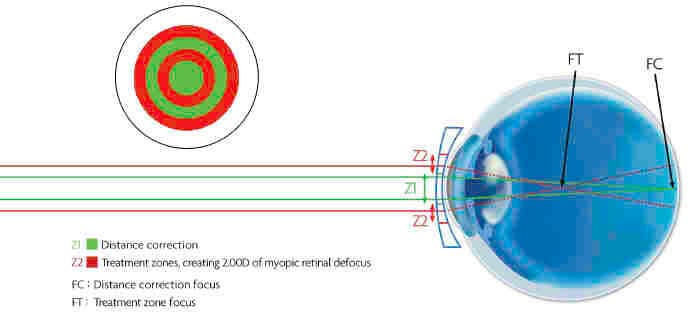
Animal models, from the likes of the American Optometric Association’s Dr Earl Smith, suggest hyperopic peripheral retinal defocus induces axial length growth and, conversely, myopic peripheral retinal defocus is protective against axial change. This underpins current theory about why multifocal soft contact lenses and ortho-k are useful for controlling myopic growth. Put simply, the relatively steep/increased plus portions within the pupil zone contribute to peripheral myopic defocus, while still focusing light accurately at the fovea. Don’t be taken in by online scaremongers, like endmyopia.org, for most levels of myopia, undercorrection of myopia will increase myopic progression more than an accurate correction³.
The main CL options
The two main soft, multifocal contact lens (SMFCL) designs used for myopia control in this part of the world are both from Coopervision, which is making a real push to dominate the specialty contact lens market worldwide, acquiring the Dutch rigid lens company, Procornea, and well-known ortho-k lens manufacturer, Paragon, last year.