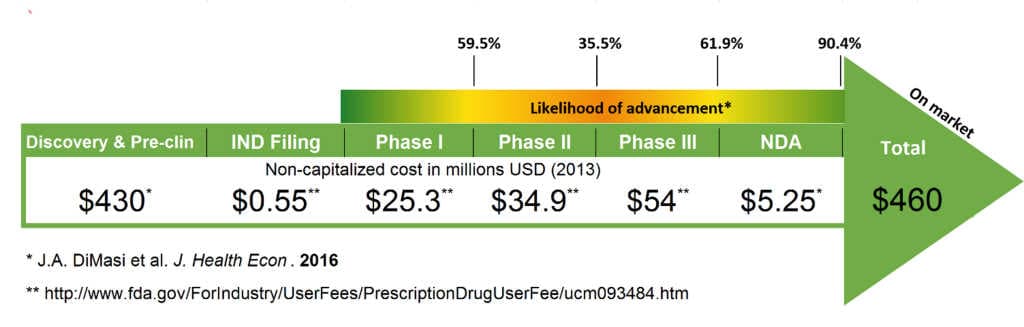
Before advancing to clinical trials, researchers must confirm there is no potential for the new molecule to cause serious harm using in vitro (cell culture) and in vivo (animal) studies. Such studies must be performed under good laboratory practice (GLP) guidelines, setting minimum requirements for personnel, equipment, protocols, operating procedures, reports and quality assurance. Pre-clinical studies are generally small with often only six replicates per treatment group. However, they must still provide sufficient detail on dosing and toxicity before the candidate can move into clinical trials.
One of the greatest challenges for translation of a drug from the laboratory bench into humans remains the poor correlation of pre-clinical data with clinical trial results often due to the different anatomy and physiology of most animal eyes. Moreover, the majority of animal disease models are acute and very homogenous while the human condition is often chronic and can vary significantly between patients. It is therefore no surprise that a number of molecules having shown great efficacy in animal studies end up failing in clinical trials.
Step 3 - Clinical research
Drug’s tested in humans to prove safety and efficacy
While pre-clinical research can answer basic questions about a drug’s safety and efficacy, it is not a substitute for studying the drug’s interactions with the human body. However, before being allowed to start clinical trials, an IND has to be submitted, including animal study and toxicity data, manufacturing information, clinical trial design, data from any prior human research and information about the investigator. The FDA then has 30 days to review and respond to the IND submission. Clinical trials are designed to answer specific research questions related to the new drug and a number of critical aspects such as patient selection criteria, participant numbers, study duration, data to be collected and how these will be analysed, need to be carefully considered. Typically, clinical trials follow a series from early, small-scale, Phase 1 studies to late-stage, large scale, Phase 3 studies followed by even larger Phase 4 trials after market approval (Table 1).