A researcher at the University of Sydney is developing a printable device that acts like a retina and could one day restore sight to blind people.
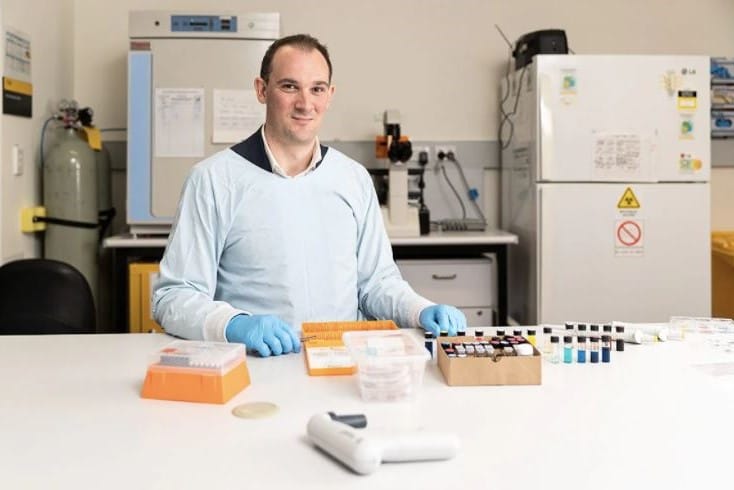
Dr Matthew Griffith, from the Australian Centre for Microscopy & Microanalysis and the School of Aerospace, Mechanical and Mechatronic Engineering, has created an electrical device from multi-coloured carbon-based semiconductors that uses absorbed light to fire the neurons that transmit signals from the eyes to the brain, acting as an artificial retina.
“Our research aims to provide a biomedical solution to those experiencing blindness from retinitis pigmentosa and age-related macular degeneration (AMD),” said Dr Griffith.
Ultimately, he said he hopes to apply the technology to restore sensory function to those with spinal cord injuries and to treat people with neurodegenerative diseases.
“A missing neuron link, which can be caused by, for example, a spinal cord injury, can cause severe problems. It can also be debilitating if neurons misfire – this can cause blindness and deafness, as well as diseases like Parkinson’s and epilepsy, for which there is no cure,” he said. “Neural interfaces can bridge this neuronal divide, or, in the case of misfiring, re-program the neurons.”