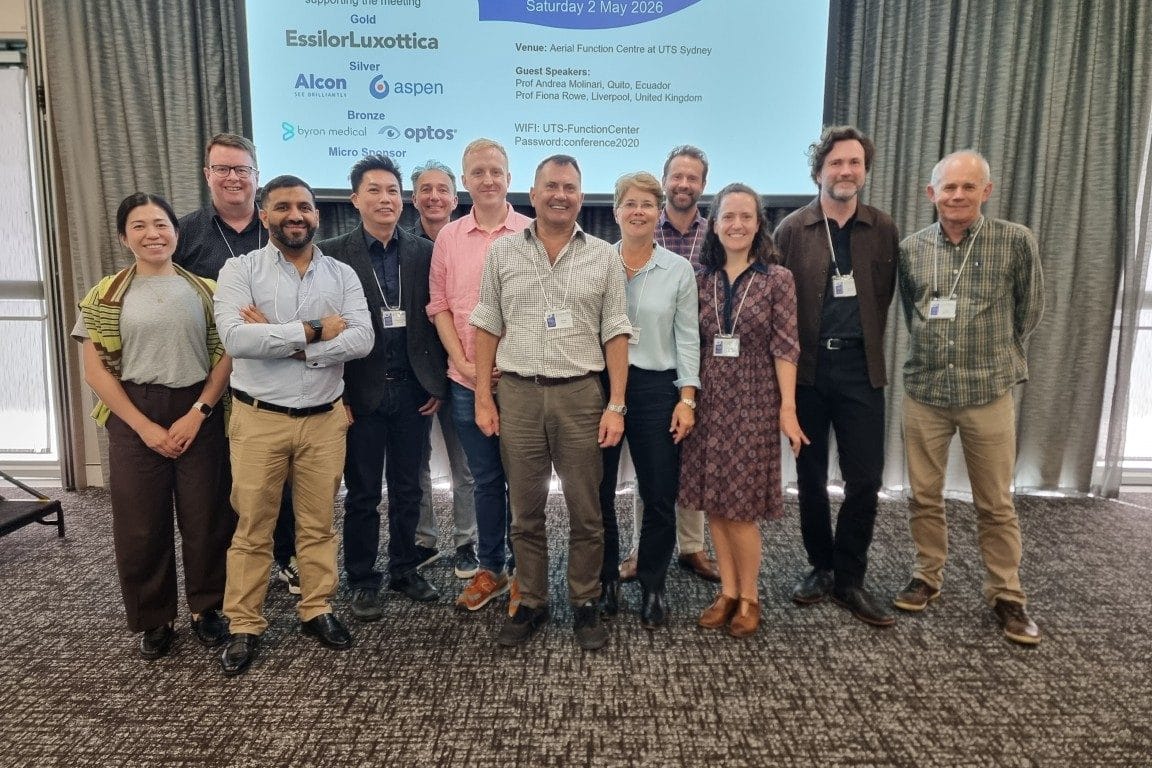
The Australian and New Zealand Strabismus Society’s (ANZSS) annual meeting in Sydney on 1–2 May was well attended and a resounding success. Among the engaging talks, the two distinguished international speakers, Professors Andrea Molinari from Ecuador and Fiona Rowe from the UK, were outstanding.
Prof Molinari is the current president of the International Strabismological Association and the director of the fellowship programme in paediatric ophthalmology and strabismus in Quito, Ecuador. She gave four talks, the first being on superior rectus contracture syndrome. This condition is characterised by a large hypertropia in primary position, which increases on abduction. There is limited depression, a very positive head-tilt test and no difference in the size of the deviation between near and distance. It can be seen in fourth nerve palsy, thyroid eye disease, dissociated vertical deviation, monocular elevation deficit, sensory exotropia and exotropic Duane retraction syndrome (DRS). A tight forced duction test in depression when the eye is in abduction is key to making the diagnosis.
Prof Molinari also spoke on the management of strabismus after trauma. When an extraocular muscle is traumatised, it can be entrapped, partially torn, contused, disinserted, lacerated or transected. A contused muscle usually improves spontaneously. If entrapped, the muscle should be operated on and released quickly, with the exception of the superior oblique, which may resolve spontaneously. A lacerated muscle should also be treated promptly to avoid adherence syndrome. But if a muscle is lost or transected, it is worth waiting as the muscle will reattach somewhere. An MRI can locate the muscle before reoperating.
Prof Molinari’s third talk addressed the surgical management of DRS. If surgery is required for an esotropic DRS patient, a unilateral medial rectus recession (of no more than 5mm) can correct up to 20 dioptres. If bilateral recession is required, the larger recession should be performed on the unaffected eye. A unilateral recess-resect procedure for an esotropic DRS should only be considered if the esotropia in primary position is greater than 25 dioptres and only then if narrowing of the lid fissure is <33% in adduction.
In exotropic DRS, an ipsilateral lateral rectus weakening with a Y-split can be used to reduce the upshoot or downshoot and reduce globe retraction. But if there is significant superior rectus overaction, the superior rectus may be recessed too. There may be bands holding the eye out, so if the forced duction test is still tight after disinserting the lateral rectus, those bands must be divided.