The authors of a US study have called into question the safety of using two companies’ repeated low-level red light (RLRL) devices for children, sparking rebuttals from one, Eyerising lnternational.
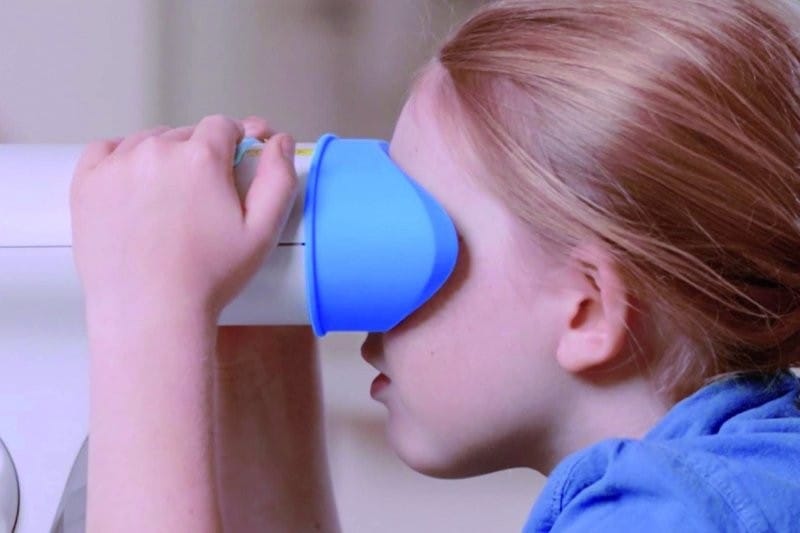
Writing in JAMA Ophthalmology, Drs Lisa Ostrin and Alexander Schill, University of Houston College of Optometry, said their study consisted of a laboratory-based evaluation of the Sky-n1201, Future Vision, Eyerising and AirDoc instruments. They found the Sky-n1201 and Eyerising devices reached American National Standards Institute (ANSI) group 1 limits within exposure times of 2.8 and 1.4 seconds, respectively – well below the recommended 180-second treatment time. They classified them as Class 1 and 2M laser devices, respectively. The Future Vision device only reached group 1 limits under extended exposure times of 253 seconds or longer but remained within Class 1 laser limits. The LED-based AirDoc produced diffuse illumination and remained well within the group 1 limit of at 22,761 seconds’ (over six hours) exposure, they said.
Drs Ostrin and Schill said the results suggest laser-based red-light therapy instruments used for the recommended duration deliver irradiance levels exceeding ANSI safety limits. “These findings, combined with emerging clinical reports of retinal damage and recent regulatory reclassification of red laser devices as Class III in China, highlight the need for rigorous, independent safety validation before widespread paediatric use,” they wrote.
The researchers previously challenged the safety of the Sky-n1201 and Future Vision devices in a separate study published in Ophthalmic & Physiological Optics in 2024. Although the Eyerising Myopia Management Device (EMMD) was not part of that study, its mention in the introduction prompted Eyerising to refute the authors’ claims at the time, alleging several inaccuracies in their study.
In response to the new study, a statement from Professor Mingguang He, chief medical officer of Eyerising International, pointed out that ANSI laser standards were primarily developed for accidental exposure scenarios and hazard classification. They are intentionally conservative and do not directly evaluate therapeutic laser exposure while treating patients, he said. “Accurate safety assessment also requires consideration of clinical usage parameters, including treatment protocols, pupil dynamics, and biologically established injury thresholds.” Further, Drs Ostrin and Schill evaluated laboratory hazard modelling rather than clinical outcomes, he said.