
Using a new imaging technique, University of Melbourne researchers have discovered the immune cells protecting the cornea are T cells, not dendritic (or Langerhans) cells, as was previously thought.
Led by Associate Professor Laura Downie, Dr Holly Chinnery and Professor Scott Mueller, the research team used a non-invasive imaging approach they termed ‘functional in vivo confocal microscopy’ (Fun-IVCM), to observe T cells moving around quickly and interacting with other cells and nerves in the outermost layer of the cornea. “We also captured different cell dynamics in response to contact lens wear and in allergic eye disease and quantified how these behaviours are modulated by drug treatments,” said A/Prof Downie.
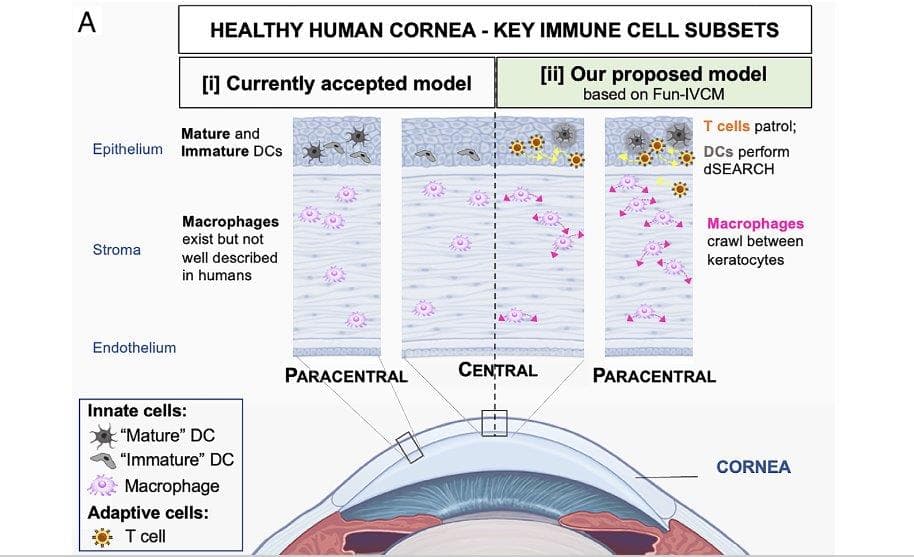
The currently accepted model of the principal immune cell subsets in the healthy human cornea, involving ‘mature’ and ‘immature’ dendritic cells in the epithelium (as imaged using traditional static in vivo confocal microscopy (IVCM) and macrophages in the stroma). [ii] A proposed role for adaptive immune cells (T cells) in homeostatic human corneal immune surveillance. Credit: University of Melbourne