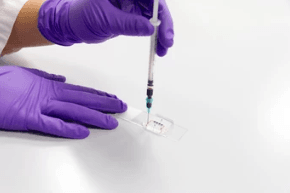
Living human cells have been combined with an artificial tissue-like system to create retina-on-a-chip technology.
Developed in Germany, the cutting-edge tool could provide an alternative to animal and organoid use in studying retinal eye disease and for testing drugs to combat it.
“It is extremely challenging, if not almost impossible, to recapitulate the complex tissue architecture of the human retina solely using engineering approaches,” said Dr Christopher Probst, co-author of the study published in eLife journal.
To overcome these challenges, Dr Probst and scientists the Fraunhofer Institute for Interfacial Engineering and Biotechnology in Stuttgart, coaxed human pluripotent stem cells to develop into several different types of retina cells on artificial tissue. This tissue recreates the environment that cells would experience in the body and delivers nutrients and drugs to the cells through a system that mimics human blood vessels.
Co-author Dr Kevin Achberger the Eberhard Karls University of Tübingen said, “This combination of approaches enabled us to successfully create a complex multi-layer structure that includes all cell types and layers present in retinal organoids, connected to a retinal pigment epithelium layer.