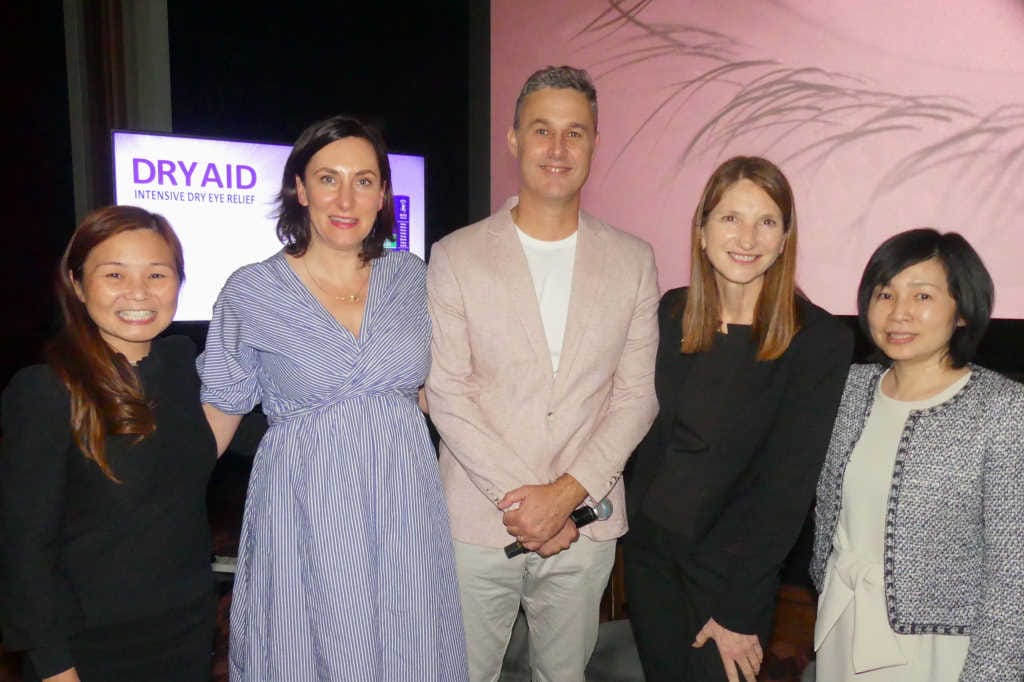
The self-proclaimed ‘world’s number one eyecare brand’, Rohto, unveiled its entry to the Australasian market at the Cornea and Contact Lens Society (CCLS) New Zealand 2024 meeting in Wellington.
The launch was backed by four of the region’s contact lens and dry eye specialists: Margaret Lam, former CCLS Australia president, now vice-president, and national president of Optometry Australia; Mark Koszek, CCLSA member and professional education officer of EyeQ Optometrists; Adele Jefferies, CCLS NZ president and national clinical manager for Matthews Eyecare; and Professor Fiona Stapleton, president of the International Society for Contact Lens Research and scientia professor at the School of Optometry and Vision Science at the University of New South Wales.
During the main CCLS NZ meeting, Koszek introduced delegates to the science behind Rohto Dry Aid lubricant eye drops, describing its mechanisms of action, its indications for use and how he uses drops as part of his own dry eye disease (DED) armamentarium. Given that “drops are the foundation stone of our entire dry treatment paradigm and should be used at every stage”, it’s crucial to find the right drop for each individual patient, said Koszek; drops that supplement the patient’s lipid layer and provide the right balance between non-polar and polar lipids. “Eighty-six percent of all dry eye is evaporative, so if you are using drops which don’t have a lipid layer stabiliser, you are probably doing your patients a disservice.”
But it’s naive to think one ingredient is the answer, he said, which is why he was attracted to Rohto’s drops. Along with other ingredients these drops combine sesame oil, which aggregates with meibum, complements the non-polar layer and has anti-inflammatory and anti-oxidative properties, and castor oil, which increases lipid layer thickness and tear breakup time and has anti-microbial properties. The drops also contain menthol, which at low concentrations creates a cooling sensation and increases basal tear secretion, Koszek said. “So it’s been designed to supplement all layers of the tear film.”
Although he’d only used Rohto’s drops for a couple of months prior to attending CCLS NZ, Koszek said he’d had some good results. These included an 89-year-old patient who was struggling with DED, hadn’t responded well to other drops and had been told she was ‘too old’ for autologous serum. After one week with Rohto drops, her tear breakup time went from a very poor 5-6 seconds to more than 15 seconds, he said. The patient reported: “They are really good; they are cool when they go in; the stinging and wateriness has stopped.”