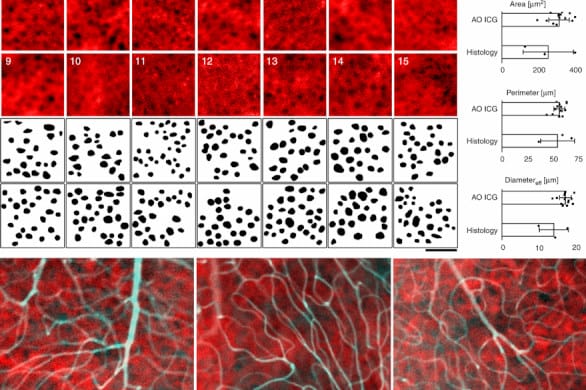
By combining two imaging modalities - adaptive optics and angiography - American investigators at the National Eye Institute (NEI) say they can see live neurons, epithelial cells, and blood vessels deep in the eye’s retina. Resolving these tissues and cells in the outermost region of the retina in such unprecedented detail promises to transform the detection and treatment of diseases such as age-related macular degeneration (AMD).
“For studying diseases, there’s no substitute for watching live cells interact. However, conventional technologies are limited in their ability to show such detail,” said the paper’s lead author, Dr Johnny Tam.
Biopsied and postmortem tissues are commonly used to study disease at the cellular level, but they are less than ideal for watching subtle changes that occur as a disease progresses over time. Technologies for noninvasively imaging retinal tissues are hampered by distortions to light as it passes through the cornea, lens, and the gel-like vitreous in the centre of the eye.
Tam and his team turned to adaptive optics to address this distortion problem. The technique improves the resolution of optical systems by using deformable mirrors and computer-driven algorithms to compensate for light distortions.
The NEI researchers combined adaptive optics with indocyanine green angiography, an imaging technique commonly used in eye clinics that uses an injectable dye and cameras to show vessel structures and the movement of fluid within those structures. In an observational study involving 23 healthy subjects, the researchers said the multimodal approach enabled them to see for the first time a complex unit of cells and tissues that interact in the outermost region of the retina. The unit includes light-detecting photoreceptors, retinal pigment epithelial cells, which nourish the photoreceptors, and the surrounding choriocapillaris, capillaries that supply the outermost region of the retina with blood.