While cataract surgery with phacoemulsification has for many years been recognised to be one of the safest and most effective surgical procedures, there remain several areas where technological advancements could potentially increase surgical success. With the development of their new ZEISS QUATERA 700 phacoemulsification system, ZEISS has recognised that one such area is in optimising chamber stability.
To address this challenge, ZEISS has taken an innovative approach and introduced the patented QUATTRO Pump, a feature which sets the QUATERA 700 apart from other phacoemulsification machines in its design and performance for controlling fluidics. Differing from venturi and peristaltic pumps, The QUATTRO Pump is a synchronised fluid exchange system that directly measures and simultaneously controls both infusion and aspiration volumes in real-time. It actively compensates for incision leakage volume. The QUATTRO Pump enables rapid stabilisation of free flow state IOP after occlusion break in about 200ms (Carl Zeiss Meditec data).
So how does this translate into real-world experience? Associate Professor Kris Rallah-Baker* was one of the first Australasian surgeons to get his hands on the system, initially in a wet lab setting and subsequently across multiple clinical cases. His feedback was unequivocal, “I found the QUATERA 700 to be a brilliant machine! I maintained a stable anterior chamber for the entire case, which allowed efficient and effortless removal of the quadrants.” He also heralded the effectiveness of the varying modes offered by the system, “Both Flow and Vacuum modes have delivered chamber stability and efficient cataract removal,” he said.
Elsewhere on the system other technological advances are evident. The ZEISS QUATERA 700 also has Automated Ultrasound Power on Demand, meaning that ultrasound is delivered only when it is needed. Unlike with other phaco machines, when operating with the QUATERA there is no need to repeatedly use the foot pedal to control ultrasound power. With Power on Demand, ultrasound is only provided when full occlusion is detected and ultrasound is deactivated when the occlusion breaks, thus reducing the ultrasound energy to a minimum.
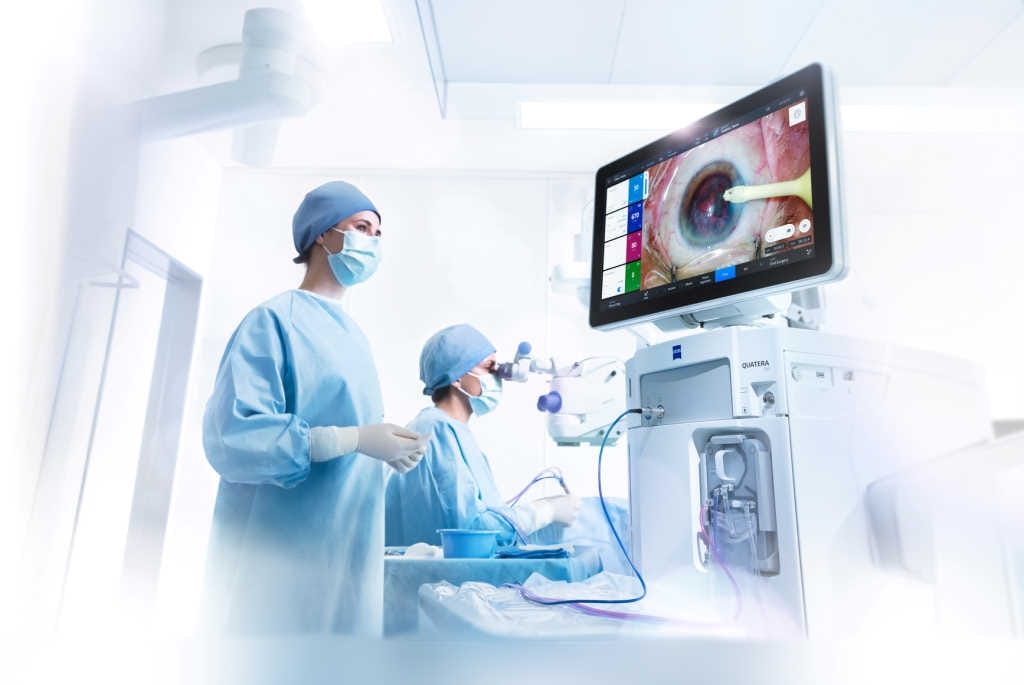
Another design element of the new phaco machine that is proving popular is the phaco screen which integrates the microscope view. This allows the OR staff to see what the surgeon sees. By having a real-time perspective of how the surgery is progressing, the OR nurse can anticipate the next steps and have the necessary instruments ready when the surgeon needs them, enabling OR workflow efficiency.
The ZEISS QUATERA 700 is also capable of digital integration with the IOLMaster and CALLISTO eye. It allows surgeons to see patient data from the IOLMaster displayed on the QUATERA screen and to have the integrated workflow of the CALLISTO eye assistance function on one sterile cockpit. This digital integration of technology brings important benefits such as streamlining cataract surgery workflow and reducing the potential for human input errors.