University of Auckland researchers say affordable, infrared eye tracking could be more effective than current standard clinical tests at detecting and measuring strabismus in patients.
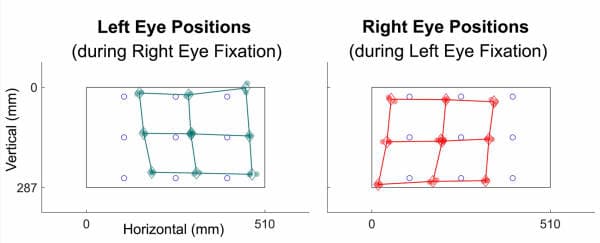
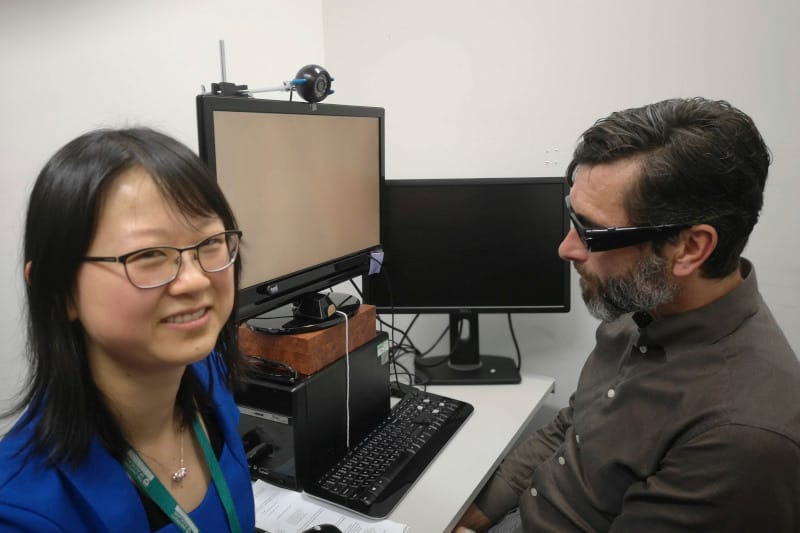
The School of Optometry and Vision Science’s (SOVS’) digital cover test uses a consumer-grade infrared eye tracker and 3D display and is based on early work by Professor Peter Bex, a psychology professor at Northeastern University in the United States. The new system can provide automatic, accurate and reliable measures of ocular deviations such as strabismus or phorias, including comitancy, said postdoctoral researcher Dr Tina Gao, who presented a poster this work at the recent Association for Research in Vision and Ophthalmology (ARVO) meeting.
“The lack of objectivity in the current standard prism cover test remains a challenge,” said Dr Shuan Dai, co-principal investigator and paediatric ophthalmologist. “As a clinician, I have always been interested in a device to make this job quicker and more accurate, so I spoke to SOVS about it. I am very excited to see the progress we have made so far.”
The devil is in the detail when it comes to objectively measuring strabismus, said SOVS head, Professor Steven Dakin who is developing the test with Dr Gao in Auckland and Prof Bex in Boston. “The gold standard for measuring ocular deviation angles is the prism and alternate cover test (PACT), in which the patient’s eyes are alternately covered with a paddle and a clinician uses the patient’s eye movements to estimate the deviation. However, this test is time consuming and its accuracy is dependent on clinician skill. Doing the test at just one direction of gaze - which is usually central - can indicate strabismus but doing it at multiple locations gives a more complete picture of the problem.”
The new system uses shutter glasses to control what each eye sees while the eye tracking device records the movements of each eye in response to stimuli on a computer screen. By analysing re-fixation eye movements when the target switched between eyes, ocular deviation direction and magnitude can be calculated. An entire nine-point comitancy screening can be completed in under two minutes and clinicians can get extra information they may not get from the prism cover test, such as fixation instability or any variability in the eye turn, said Dr Gao.