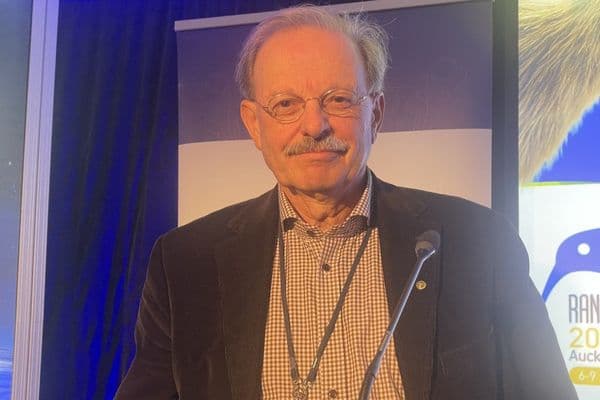
In December 2017, Dr Martin Kollmann, a consultant ophthalmologist and associate professor at the University of Nairobi, travelled to New Zealand to address delegates from the partnerships, humanitarian and multilateral division of the New Zealand aid programme at the Ministry of Foreign Affairs and Trade (MFAT). The main aim of the visit was to build awareness of the link between neglected tropical diseases (NTDs) and poverty and demonstrate how tackling NTDs is key to a region’s socio-economic development. Dr Kollman, a senior advisor on NTDs for the international charity CBM (formerly the Christian Blind Mission), was accompanied by CBM NZ chief executive, Stephen Hunt, and international programmes manager, Linabel Hadlee.
NTDs are a diverse group of tropical infections, especially prevalent in low-income populations in developing regions. They are caused by a variety of pathogens such as viruses, bacteria, protozoa and helminths. The disabling and debilitating effects of NTDs include blindness, mobility impairment, preventing children’s growth and development, malnutrition and extreme pain. They are labelled ‘neglected’ because they affect communities in extreme poverty. In some cases, the uncontrolled spread of NTDs has resulted in pastoral communities abandoning their land to escape the transmitting pathogen but, as a result of NTD control programmes, in more recent times 25 million hectares of arable land has been regained, feeding 17 million people annually.
Two of the most common blinding NTDs are onchocerciasis (river blindness), found in Africa and some parts of the Americas, and trachoma, the leading cause of infectious blindness in humans, caused by infection with the bacterium Chlamydia trachomatis, which is still found in Africa, the Americas, Asia, the Middle East and the Pacific. Ethiopia carries 39% of the global trachoma burden, with an estimated 74 million people at risk and 40% of children aged 1-9 infected. Women are highly susceptible due to greater exposure to young children, who typically spread the disease. Trachoma is active in the Pacific, particularly Papua New Guinea and Australia in remote communities.
Blindness from trachoma is irreversible. Infection is spread through personal contact and by flies that have been in contact with facial discharges from an infected person. With repeated episodes of infection over many years, a sufferer’s eyelashes may be drawn in so they rub on the surface of the eye, causing pain and permanent damage to the cornea.
CBM supports NTD control and elimination programmes in 12 countries promoting the SAFE (surgery, antibiotics, facial cleanliness and environmental educational) strategy at a community level. Over the last 12 years, CBM has funded nearly 16 million mass drug administration projects and almost 900,000 trachoma surgeries. CBM has also supported the training and education of more than 83 million health and community workers.