Dry eye research from laboratory to practice
It really is a momentous occasion when one of the Tear Film and Ocular Surface Society’s (TFOS’) global consensus reports is published: a culmination of years of work for many people, as they translat
11 articles

It really is a momentous occasion when one of the Tear Film and Ocular Surface Society’s (TFOS’) global consensus reports is published: a culmination of years of work for many people, as they translat

The impact of disease on the ocular surface is often assessed clinically by checking for fluorescein staining of the corneal epithelium, to highlight areas of damage secondary to trauma, infection or desiccation. In dry eye disease, corneal staining is typically superficial, punctate and located inf

How useful are corneal and lid margin sensitivity measures when it comes to detecting dry eye disease?

When it comes to researching in dry eye, everyone knows I’m the first to tell prospective researchers that ‘the sky’s the limit’. Well, it turns out this might be somewhat of an underestimation! Thank

Dusting off my PhD thesis recently, during a historical fact-finding mission, provided an opportunity to reflect on how far dry eye clinical care has come in the last 30 years.

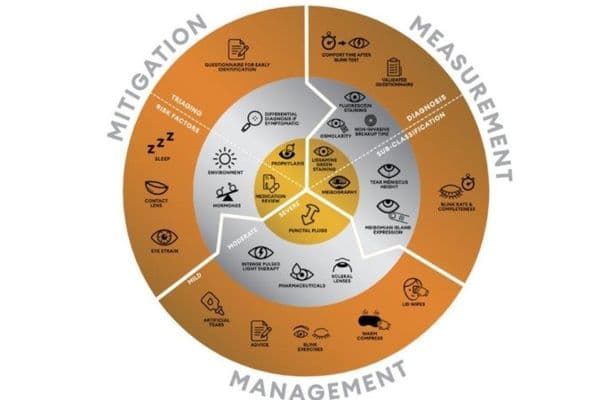
In the six years since publication of the evidence-based TFOS DEWS II reports¹, awareness and acknowledgement of dry eye disease (DED) as a growing global concern has continued to intensify. These reports reached consensus with respect to the diagnosis, classification, diagnosis and management of DE

“Flight NZ29 is ready to board at Gate 4…” I’m in transit in Houston Airport, returning from my first in-person attendance in four years at the Association for Research in Vision and Ophthalmology conference (ARVO). As I mentally prepare for the 14.5 hours aboard my waka rererangi, I reflect on what

The Tear Film & Ocular Surface Society’s (TFOS’) mission to advance the research, literacy and educational aspects of the scientific field of the tear film and ocular surface is well known. The non-profit organisation takes pride in pushing boundaries in terms of investing imagination and innova

Eyelid warming is a fundamental feature of many therapies that help restore homeostasis in meibomian gland dysfunction (MGD). Heat melts otherwise inspissated oils and encourages outflow of meibum onto the lid margin to augment and stabilise the tear film lipid layer.

The BCLA virtual conference was a breath of fresh air. Organisers took a arranged four back-to-back sessions over a 30-hour period, giving members from across the world the benefit of 'live' sessions.

Meibomian gland dysfunction (MGD) is characterised by alterations in glandular secretion and terminal duct obstruction, secondary to hyperkeratinisation of the ductal epithelium1. The oils secreted from the glands contain a mixture of lipid secretions and keratinised epithelial debris. Keratin level