A rainy, SUNY visit
Auckland-based optometrist, Kristel Venturina was awarded a Snowvision State University of New York (SUNY) final year student scholarship in 2018. Here, she shares just some highlights of her experience.
I landed in New York City at 5pm on a rainy New Year’s Eve. I was excited about my first New Year away from home. As an eager tourist, I was keen to watch the ball drop to signal the start of 2019, even though it was pouring with rain. But I ended up soaking wet, retreating to my hotel room to watch the ball drop live on YouTube!
I lived on 38th Street, 6th Avenue, which was only four blocks away from the iconic Times Square. Walking passed the blinding lights of Broadway for the first time, with the smell of hotdogs on every corner and the beeping horns of yellow taxi cabs, it finally sunk in - I was in New York!
My first day at SUNY was the coldest day recorded that winter. I was given a tour of the 12-floor building, which is divided into different specialty clinics. The building itself is situated next to the eminent Bryant Park and New York Public Library, making the views from the university extraordinary.
During my visit to SUNY, I was given the freedom to choose which specialty clinics and cases I wanted to observe. I chose to spend the majority of my time with Dr Richard Madonna and Dr Laura Dull in the glaucoma clinic.
In New Zealand, we are privileged to have a publicly funded health system with subsidised medication. In the United States, this is not the case. Because of this, prescribing glaucoma drops and other medications can be highly influenced by what is covered under the patient’s health insurance. The lack of subsidised medication and an organisation like Pharmac, means there is an abundance of prescription medication in the United States.
During my visit, I learnt about two newly FDA-approved eye drops for primary open angle glaucoma, Rhopressa and Vyzulta. Both have a dual acting mechanism designed to directly target the trabecular meshwork. Vyzulta is formulated to release nitric oxide, which relaxes the trabecular meshwork to increase aqueous flow. There has also been the suggestion that nitric oxide can increase ocular perfusion pressure. While Rhopressa is a rho-kinase inhibitor. Rho-kinase enzymes regulate cell shape and movement. The inhibition of these enzymes initiates the relaxation of the trabecular meshwork and, consecutively, Schlemm's canal, and is thought to promote retinal ganglion cells survival.
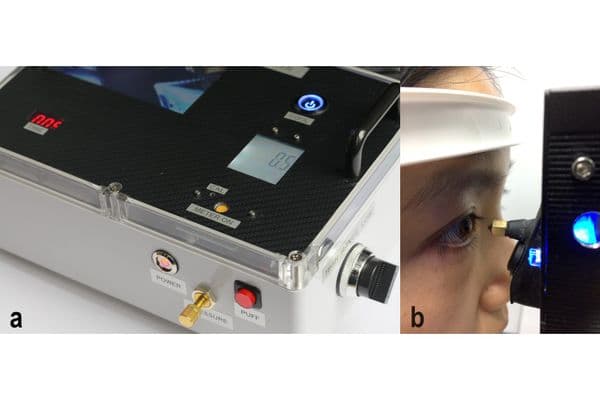
I was also impressed by the advanced technology that was available at SUNY. While I was there, I was introduced to SITA-faster and the ocular response analyser. The ocular response analyser is a non-contact tonometer, which can measure the flexibility of the cornea (corneal hysteresis). This value defines the ability of the cornea to absorb and release energy and was found to be lower in patients with any classification of glaucoma, making it a measurable risk factor.

SITA-faster is the latest in visual fields analysis, incorporating 10-2 into the standard 24-2 testing. The new programme, known as 24-2c, includes 10 additional points that test the central visual field to detect macular defects.
During my visit to the neurology clinic, I observed some of the devastating repercussions of increasing obesity, including heightened cases of idiopathic intracranial hypertension and, consequently, papilloedema. The increase in intracranial hypertension has been linked to compromised ability to reabsorb intracranial fluid and reduced cranial venous flow in patients with obesity.
The university works closely with the area’s ophthalmologists and ophthalmology researchers. Patients seen by students and residents at the university who require a laser procedure are scheduled an appointment with a visiting ophthalmologist. During my visit, I had the opportunity to watch various procedures including SLT, LPI and fluorescein angiography.
Visiting SUNY as a new graduate far exceeded my expectations. Not only was I exposed to a large volume of cases which, for the most part, I was observing for the first time, but I was also able to see how quickly our profession is advancing. It opened my eyes to the future of our profession.
Two Snowvision SUNY scholarships are awarded each year to a New Zealand optometrist and a final year student completing a BOptom. Recipients attend SUNY in New York for four weeks with a maximum NZ$7,000 to cover travel from Auckland to New York and tuition fees. To apply, email Hamish Caithness at [email protected]
Snowvision, the biennial conference in Queenstown, returns from 5-8 Aug 2020.