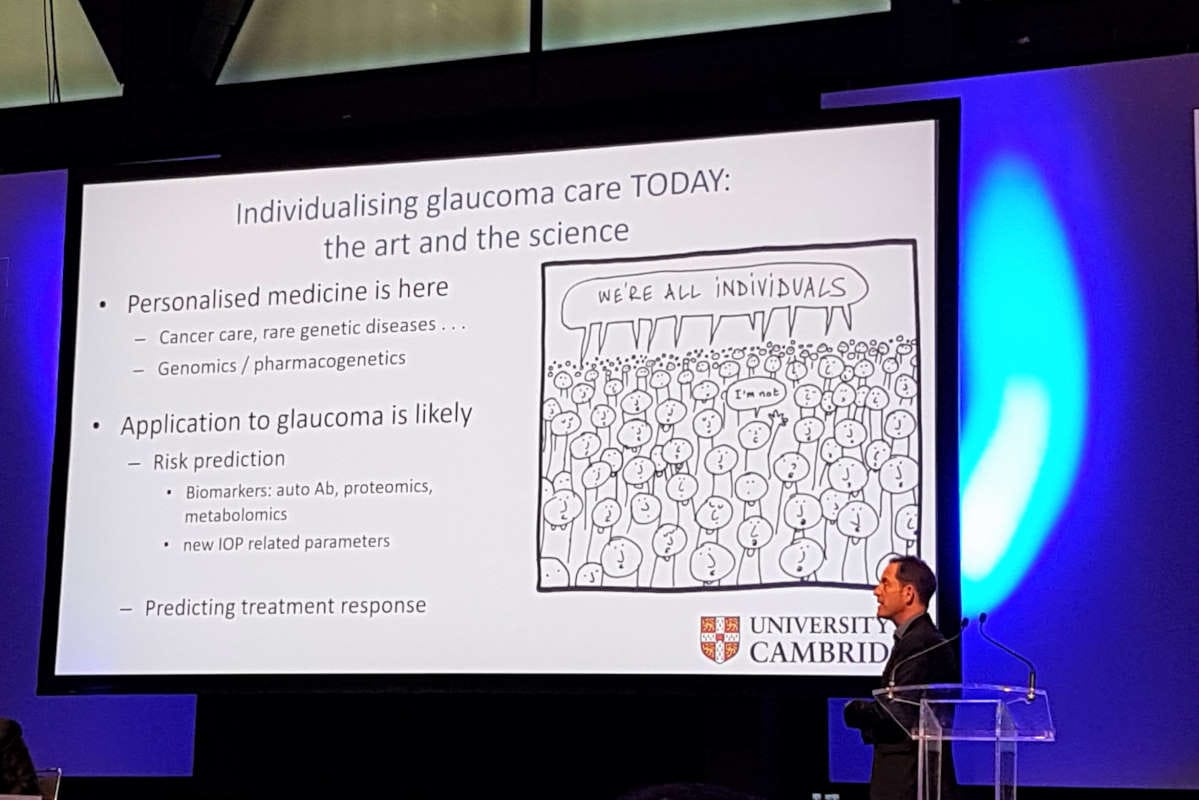
Personalised medicine, moving away from a one-size-fits-all approach, is a big thing in today’s British National Health Service and this can make a big difference for glaucoma patients, said Professor Keith Martin, head of ophthalmology at the University of Cambridge.
Speaking at Allergan’s Beyond glaucoma meeting in Sydney in July, Prof Martin, the meeting’s keynote speaker, said primary open-angle glaucoma (POAG) tends to be considered as one disease with one treatment path - lowering intraocular pressure (IOP) - despite patients being very different and having a range of other conditions.
“If you look at what’s happened in other areas of medicine in recent years, they have been revolutionised by their ability to diagnose specific variants of their disease more accurately.” This is particularly true for breast cancer, with every UK patient now molecularly phenotyped and their treatment plan designed to fit to their specific form of breast cancer.
Driving this personalisation are advancements in understanding our own genomes and technology innovations. Technologies like the Sensimed Triggerfish contact lens sensor which can detect IOP-related changes over a 24-hour period, may help provide a better understanding of a patient’s glaucoma: slow versus fast progression or stable ocular hypertension versus ocular hypertension converting to glaucoma, said Prof Martin. “Health systems and health providers are now looking at ways to integrate this knowledge into patient care… to help us predict risk for diseases like glaucoma; who’s going to do well and who’s going to do badly and so will need more resources devoted to them.”
Within glaucoma there’s been a plethora of innovations in recent years, such as minimally invasive glaucoma surgery (MIGS) and Allergan’s Xen Gel stent. But that makes it even more important to work out which treatment is the best for each, individual patient, he said. “Because none of these treatments are right for everyone.”