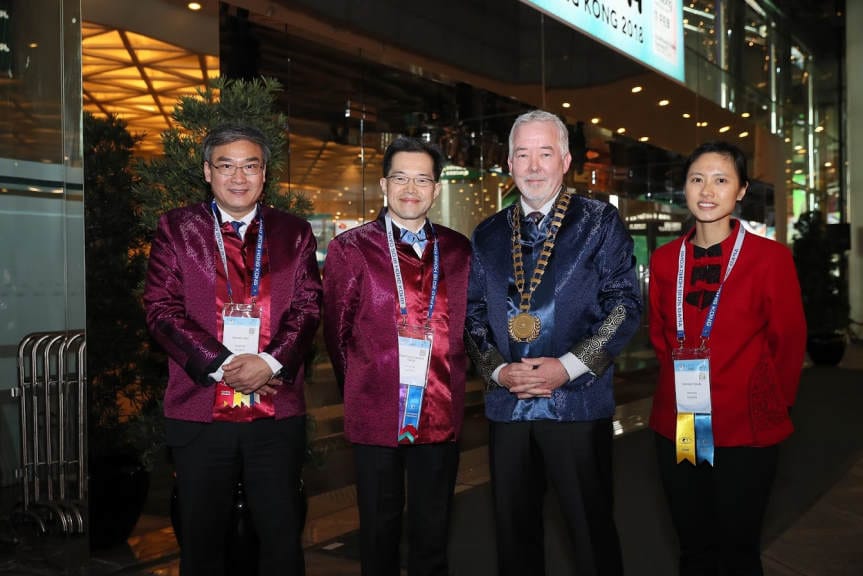
This year, the 33rd Asia-Pacific Academy of Ophthalmology (APAO) Congress was held in "Asia’s world city", Hong Kong, where we were welcomed by unseasonably cold weather. The congress itself, however, warmed up the atmosphere quickly with more than 5,200 delegates from 87 countries attending; predominantly ophthalmologists, but also optometrists and vision scientists from across the world. Perhaps in honour of own Professor Charles McGhee, chair of ophthalmology at the University of Auckland and new APAO president, delegates were warmly welcomed by kilt-wearing, bagpipe players at the opening ceremony.
This year's meeting lived up to its theme, 'Creativity and technology without boundaries’, offering many opportunities for young clinician-scientists to interact with their seasoned and experienced peers across the spectrum of ophthalmology and lots of news about new technological advances.
The use of artificial intelligence (AI) using ‘deep learning’ – complicated software algorithms that allow powerful computers to "learn" from large datasets – is expected to revolutionise retinal examination. Deep learning uses artificial neural networks that allow machines to process and perceive the world in a similar way to humans, but with far, far greater speed and accuracy and without any bias. A research study in Thailand used this modality for diabetic retinopathy screening studies. According to the Thai researcher Dr Paisan Ruamviboonsuk, the very same technology may also be able to process retinal images to predict refractive errors, cardiovascular risk and cancer biopsies. AI certainly became a virtual theme (pun intended!) of the conference. In fact, one session was dedicated just to AI-based screening with presentations focusing on diabetic retinopathy, glaucoma and age-related macular degeneration.
Another entertaining yet equally educational session from this year's APAO meeting, was the ‘Ophthalmic premier league’, where four teams, in team jerseys no-less and accompanied by music galore, discussed challenging and complicated cataract cases together with different, potential lines of action. The resulting laugh-riot was full of confusion yet still delivered some excellent pearls to deal with unusual characters and cataracts.
As APAO president, Prof McGhee had a busy schedule with a number of different speaking engagements, including seven scientific lectures! These ranged from the truly educational, on iris melanoma and corneal transplants, to some more entertaining ones, including, ‘Chevalier Taylor, the oculist who blinded Handel and Bach: self-promoting quack or the target of fake news’. The lecture was as informative as its intriguing title!