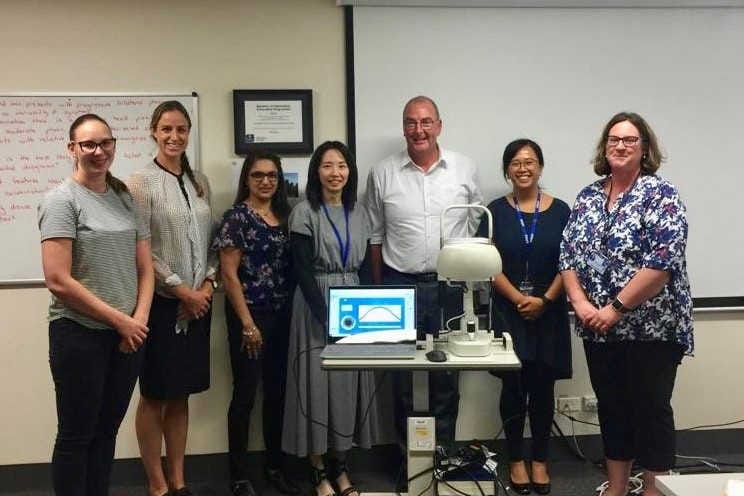
Corneal Lens Corporation (CLC) has loaned the Auckland District Health Board (ADHB) the sMap 3D – a state-of-the-art corneal topographer for designing custom-made rigid gas permeable contact lenses. Patients from Greenlane Clinical Centre (GCC) and Counties Manukau Superclinic with complex irregular corneas and who cannot wear standard semi-scleral contact lenses, can now have their contact lenses accurately designed using the sMAP 3D.
Excited ADHB optometrists have received their training from CLC director Graeme Curtis and have begun using the instrument to fit contact lenses with their difficult cases. Curtis said, “The sMAP will change the way we measure ocular surface topography. Standard Placido disk slope measurements are great for optical power measurements on the central regions of the cornea, but provide poor elevation topography, making them poor choices for specialty contact lens fitting. The sMap 3D topographer addresses this problem by providing direct anterior surface elevation measurements, letting you map the complete three-dimensional eye surface within 10 um precision.”
The sMAP uses 3D stitching algorithms to accurately combine multiple measurements and increase topographical range, allowing the practitioner to map the entire scleral surface including the area under the eyelids. Curtis described how the instrument will help in practice, “This technology is at the forefront of custom contact lens design, making fitting simpler and more accurate and helping to reduce chair time, and costs, for the practice and the patient. The custom lens composer allows the optometrist to design a custom-made lens with the file sent directly to our laboratory for manufacturing.”
Curtis said CLC decided to assist ADHB with their challenging contact lenses cases to help them improve time management, reduce patient backlog and costs for the department, enabling patients to receive the best custom-made lens possible. “The sMAP technology allows for a complete understanding of the anterior surface and given the complex cases the ADHB see every day, will allow for better patient outcomes.”
GCC’s allied health manager Carly Henley said the GCC optometry team carry out four specialised contact lens clinics per week, which equates to approximately 1,800 appointments per year. She said patients ranging from six weeks old to 100 years have been seen, with various pathologies including advanced keratoconus, irregular corneas following injury or trauma, post-operative corneal ectasia, post graft, unilateral and bilateral aphakic children and occlusive or cosmetic contact lenses. “A big thank you to Graeme Curtis at CLC for his generosity in providing the sMAP on loan to provide our patients with the accurate anterior eye assessment to provide custom-made contact lenses.”