In the early 19th century, the common hypothesis was that some ophthalmic diseases came from “inside the eye”, but there was no reliable way to view a retina safely. The red flex was the only sign to look for and it was done with the patient in a prone position on a bed and the clinician in a supine position holding a candle. It was not until 1851 that Professor Hermann von Helmholtz invented the ophthalmoscope. He called it an augenspiegel or “eye mirror”.
Prior to Helmholtz, the earliest noted fundus visualisation of living eyes was carried out by Dr Jean Méry in 1704. He placed a cat under water and noticed the retinal vessels became distinctly visible. In 1825, Jan Purkinje constructed a crude ophthalmoscope using his myopic spectacles and a candle. His findings, however, were unrecognised for many years as his dissertation was in Latin. Two decades later, William Cumming from London found an eye could be made luminous if the axis from a source of light directed towards a person’s eye and the observer’s line of vision were coincident.
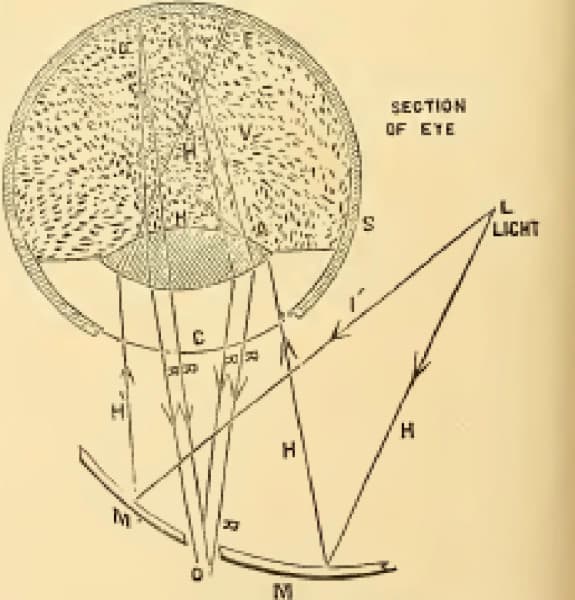
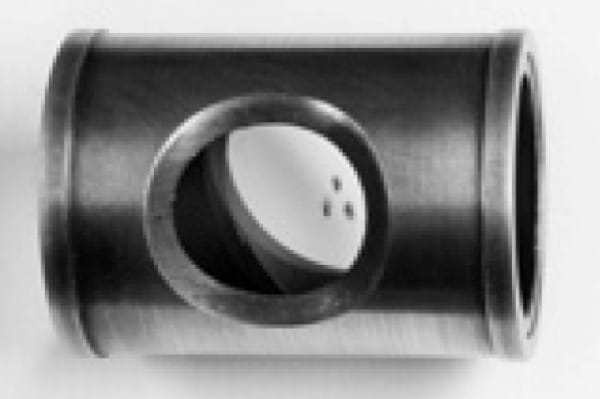
In 1847, mathematician and inventor Charles Babbage was the first to construct an instrument for retinal examination. The “Babbage ophthalmoscope” (Fig. 1) was optically close to the modern-day direct ophthalmoscope, but ophthalmologist Dr Thomas Wharton rejected Babbage’s invention as of little value, describing it as a ‘plain mirror’. Little did he know that it could have worked with the addition of a -4 or -5 diopter lens inserted between the observer’s eye and the back of the plano mirror from which two or three holes had been scraped.
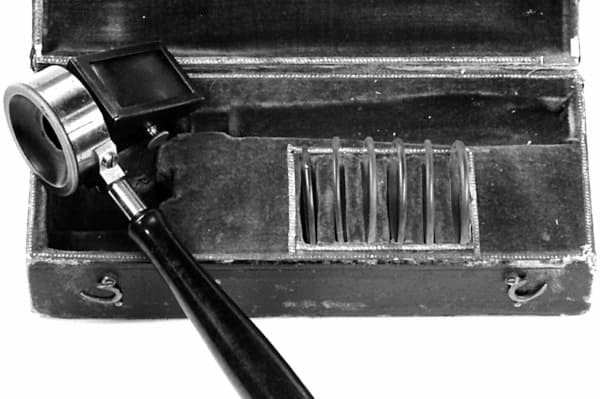
Hermann von Helmholtz, however, recognised there were three principles to be solved to view the retina effectively: the eyes of the observer and the patient had to be emmetropic; the retina must be illuminated; and the light source and the observer’s pupil had to be aligned. He presented his revolutionary design to the Berlin Physical Society in 1851.